Finger Lakes
Long blue corridors cut through New York's hill country
Nations 10

The Geography
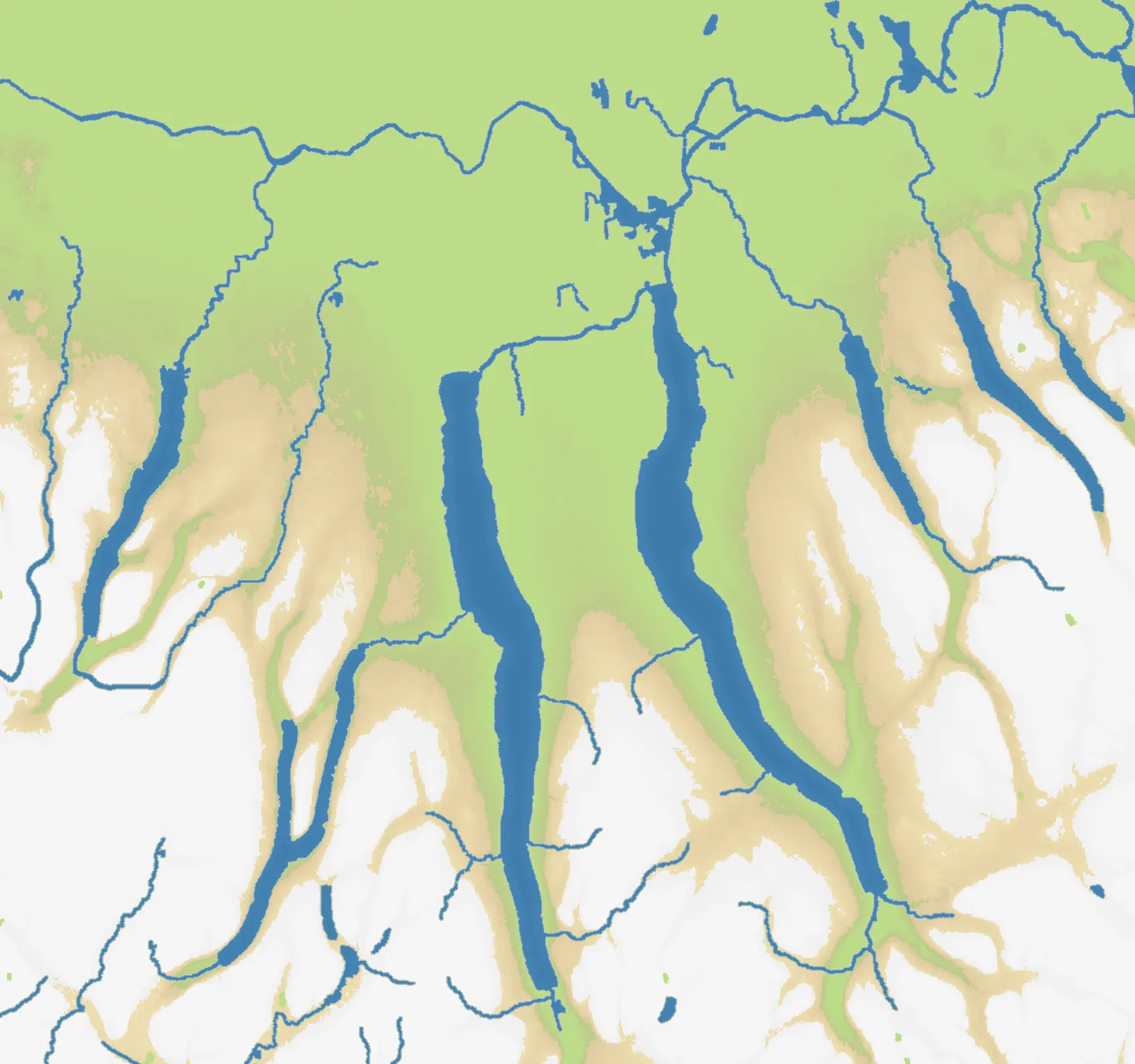
Finger Lakes maps the glacially carved lake country of central New York. Long, narrow lakes run through wooded ridges and open farmland, turning the landscape into a set of parallel corridors. The water is never just scenery: it separates fronts, protects flanks, and makes the crossings between valleys the natural points of contact.
The surrounding towns give the map its human scale. Ithaca and Watkins Glen anchor the southern edge, while Geneva, Seneca Falls, Auburn, Skaneateles, and Lyons sit along the northern approaches. Penn Yan, Hammondsport, and Canandaigua fill the interior, where a player can expand across the ridges but cannot ignore the lake mouths.
The History
Ice-Shaped Country
The Finger Lakes valleys were deepened by glaciers, leaving the distinctive long lakes and steep slopes that define the region. Their shape still determines where roads, towns, and movement can fit.
Haudenosaunee Homeland
The region was home to Haudenosaunee communities, including the Seneca and Cayuga nations. The lakes and connecting waterways supported travel, trade, diplomacy, and agriculture long before the modern town network appeared.
Canal and Agricultural Frontier
After European settlement, farms, mills, and lake ports tied the interior to the wider markets of New York. The Erie Canal connection strengthened the northern end of the region, while vineyards and orchards became lasting features of the lake shores.
The Battlefield
Terrain Overview
Finger Lakes is a map of divided movement. The lakes form long defensive walls, but their ends are gateways: holding a northern or southern outlet can open a route behind an opponent’s ridge line. Central positions have options, while edge positions often have room to grow at the cost of slower access to the main crossings.
Best Spawns
- Geneva and Seneca Falls — central northern positions with access to several lake corridors.
- Penn Yan and Hammondsport — interior footholds that can contest the middle before the shores harden into fronts.
- Ithaca and Watkins Glen — southern anchors with clear routes north, provided the nearby crossings are secured early.
Avoid
- A remote end of a lake — easy to defend at first, but vulnerable to being cut off from the rest of the map.
- A shoreline pocket with one exit — water may cover a flank while turning the remaining land route into a single point of failure.
Strategic Insights
Treat each lake as a wall with doors at both ends. Early expansion should aim for the doors, not simply the nearest open land. A player who controls a crossing can shift between shores and threaten the rear of a rival who committed to one long corridor.
The safest rhythm is to establish a compact base, secure one outlet, then widen across the ridge. Overextending along a shoreline creates a long front that is difficult to reinforce; keeping a reserve near the central crossings makes it easier to choose where the next fight happens.
Fun Facts
- The lakes’ unusual length and narrowness are the signature result of glacial valleys.
- Seneca Falls is associated with the 1848 women’s rights convention, linking the battlefield to a major moment in American reform history.
- The region’s lake-moderated climate helped make its shores known for vineyards and orchards.