World
The original theatre of everything
Nations 61


















The Geography
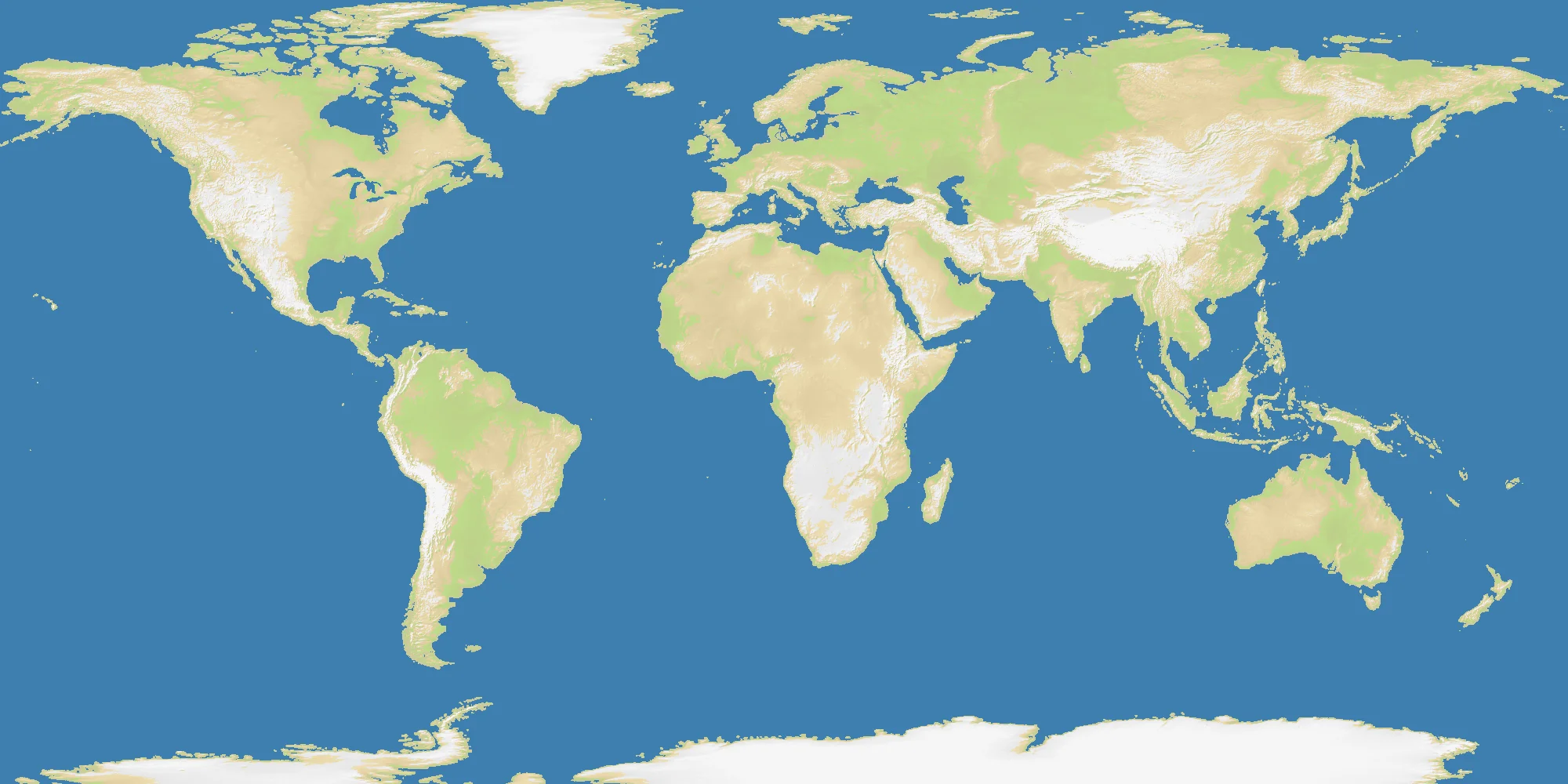
The World map traces the familiar outline of Earth’s seven continents spread across a 2000×1000 canvas. Every major landmass is here in miniaturized form — the Americas flanking the Atlantic, the connected sprawl of Europe-Asia-Africa dominating the eastern hemisphere, and the distant islands of Oceania clinging to the far right edge. Oceans cover 67.4% of the surface, making this one of the most water-dominant maps in the game.
The map compresses real geography into playable terrain: mountain chains run through the Rockies and Andes, the Sahara and central Asia read as arid plains, and the dense vegetation of the Congo basin creates its own chokepoints. At 2000×1000, it’s large enough to feel genuinely global while small enough for games to reach meaningful conclusions.
The History
200,000 BCE — Out of Africa
Modern humans emerged in sub-Saharan Africa and gradually spread across the globe. Every landmass on this map was eventually reached — a migration story that played out over tens of thousands of years and that the game’s spawn mechanics unconsciously echo every time you place a nation.
1492 — The Age of Sail
Columbus’s crossing of the Atlantic marked the moment when the Eastern and Western hemispheres became permanently entangled. Trade routes, colonial empires, and mass migration reshaped every continent on this map within the following century, drawing the political borders that still loosely define the nations here.
1945 — The World Remade
Two world wars in thirty years redrew this map more dramatically than any event since. Empires dissolved, new nations emerged, and the bipolar Cold War replaced old European dominance with a superpower standoff. The 61 nations on the World map are a compressed echo of that post-war order.
The Battlefield
Terrain Overview
With 61 nations competing across 32.6% land tiles, the World map is simultaneously the most familiar and most contested of all continental maps. Choke geography matters: the Suez region, the Panama isthmus, and the Bering crossing all create natural chokepoints that become critical early in a match. Naval power is indispensable — 67.4% water means island nations and coastal powers can use the ocean as both highway and barrier.
Best Spawns
- Scandinavia / Northern Europe — sheltered northern flank, natural mountain barriers, multiple expansion routes south and east
- Central Asia — massive land buffer, surrounded by nations to absorb, distant from the naval-dominant zones
- Southern South America (Patagonia region) — isolated tip, limited initial neighbors, room to grow north
Avoid
- Small island nations — Oceania, Caribbean, and Pacific chains are easy to isolate and naval-lock before you build momentum
- Western Europe — high nation density, contested from all sides immediately
Strategic Insights
The water coverage (67.4%) makes naval investment mandatory for any player hoping to control trade lanes or strike across oceans. Land bridges — particularly the Central American isthmus and Southeast Asian archipelago — become strategic flashpoints that experienced players contest early. At playlist frequency 20, this is the most-played map in the game: reading the game flow here gives you transferable knowledge to almost every other map.
Fun Facts
- World appears 20 times per playlist rotation — more than any other map by a wide margin
- At 61 nations, it’s second only to Giant World Map (97 nations) in population density
- The map’s 32.6% land coverage closely mirrors real Earth’s ratio of ~29% land surface