Strait of Hormuz
Narrow waters, global stakes, no mistakes
Nations 20
The Geography
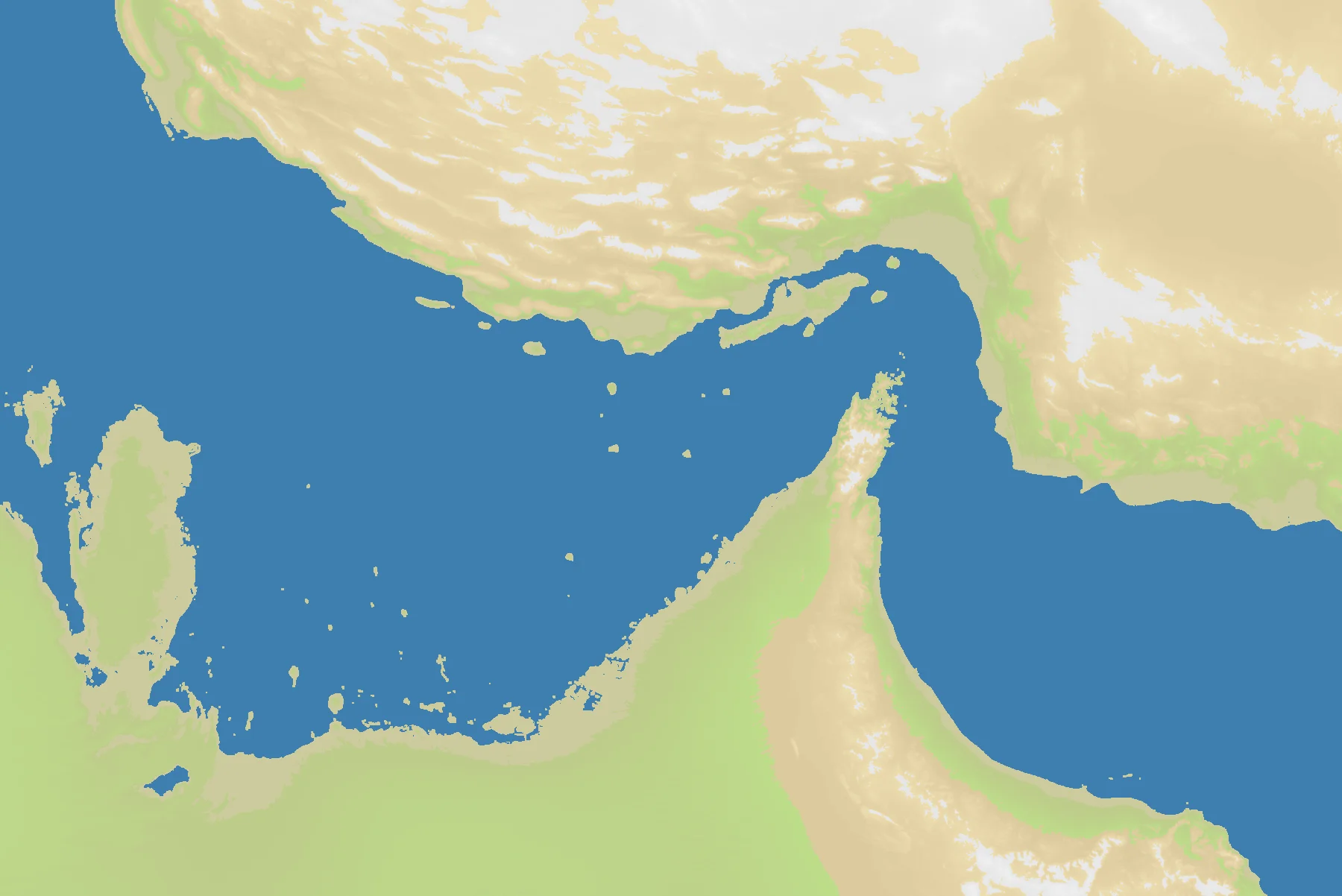
The Strait of Hormuz is the narrow maritime exit from the Persian Gulf to the Gulf of Oman and the Arabian Sea. Iran controls the northern shore; Oman, via the Musandam Peninsula, controls the southern side. Nearby lie the coasts of the United Arab Emirates and, deeper inside the Gulf, the ports of Kuwait, Iraq, Bahrain, Qatar, and Saudi Arabia. It is one of the clearest real-world chokepoints on the planet: a confined waterway through which an extraordinary share of global energy traffic passes.
That strategic compression translates perfectly into map design. At 1800×1200 with 58% land, this regional battlefield is balanced between shoreline maneuver and inland consolidation. The strait itself is narrow enough to feel constantly contested, while the broader Persian Gulf behind it creates space for naval buildup and flanking routes. Twenty nations is a high count for such an economically important corridor, so the early game tends to be crowded and highly political.
Unlike open-ocean maps, Hormuz never lets players forget where the center is. The coasts are jagged, the peninsulas are exposed, and the islands matter because they sit in shipping lanes rather than far from them. The result is a map where a few kilometers of water can decide everything.
The History
Antiquity — Gulf Trade Routes
For thousands of years, the Persian Gulf connected Mesopotamia, Persia, Arabia, and the Indian Ocean world. Pearls, dates, horses, spices, and textiles moved through these waters long before oil gave the region its modern reputation.
1507 — Portuguese Capture Hormuz
The Portuguese seized the island kingdom of Hormuz in the early sixteenth century and built a fort there to control Gulf trade. Their occupation showed how a maritime empire could project immense power through a very small bottleneck.
1800s — British India Sea Lanes
As the British Empire consolidated control over routes to India, the Gulf became a zone of treaties, patrols, and imperial influence. Securing maritime passage through and around Hormuz was vital to linking Bombay, Basra, and the wider imperial system.
1970s–Present — Oil Chokepoint of the Modern World
In the late twentieth and early twenty-first centuries, the strait became synonymous with energy security. Tanker wars, sanctions crises, naval patrols, and repeated threats of closure all reflect the same reality: a narrow channel here can shake the global economy.
The Battlefield
Terrain Overview
Hormuz is a contest between concentration and reach. The northern Iranian shore is long, rugged, and rich in positions, but it can become overextended if too many fronts open at once. The southern shore is more fragmented, with peninsulas and smaller coastal states that can either cooperate or be picked apart. The strait itself is the pressure point, but the deeper Gulf is where empires gather strength.
Islands and promontories matter more here than their raw size suggests. A small base with naval range over the main channel can punch far above its weight. Likewise, players who spawn deeper inside the Gulf may enjoy safer early expansion, but they eventually have to confront whoever controls the exit.
Best Spawns
- Musandam-Omani side of the strait — immediate leverage over the chokepoint and strong defensive geometry.
- Southern Gulf coast near the UAE — dense neighbors, quick growth, and access both inward and outward.
- Central Iranian shore — strong land base with multiple ports and room to scale.
Avoid
- Tiny exposed islands in the channel — powerful if supported, but usually the first places to be isolated.
- Far inner-Gulf cul-de-sacs — safe early, slow later, and too dependent on one exit route.
Strategic Insights
Control of Hormuz is less about sitting directly on the strait and more about controlling the approaches on both sides. If you dominate only the north shore or only the south shore, you can still be contained. The strongest position combines one secure coastal base with enough fleet presence to threaten passage at will.
Because the map is 58% land, a pure naval strategy is rarely enough. You need ports, hinterland, and production. But because the water is so strategically dense, a player who ignores sea control can lose their empire’s relevance overnight. Build for combined arms from the beginning.
Fun Facts
- Roughly one-fifth of global petroleum liquids trade has moved through the Strait of Hormuz in recent years, depending on market conditions.
- The Strait of Hormuz is only a few dozen kilometers wide at its narrowest point, despite its massive global importance.
- The Portuguese Fort of Our Lady of the Conception still stands on Hormuz Island as a reminder that this chokepoint has been contested for centuries.