Strait of Gibraltar
The hinge between two worlds
Nations 7
The Geography
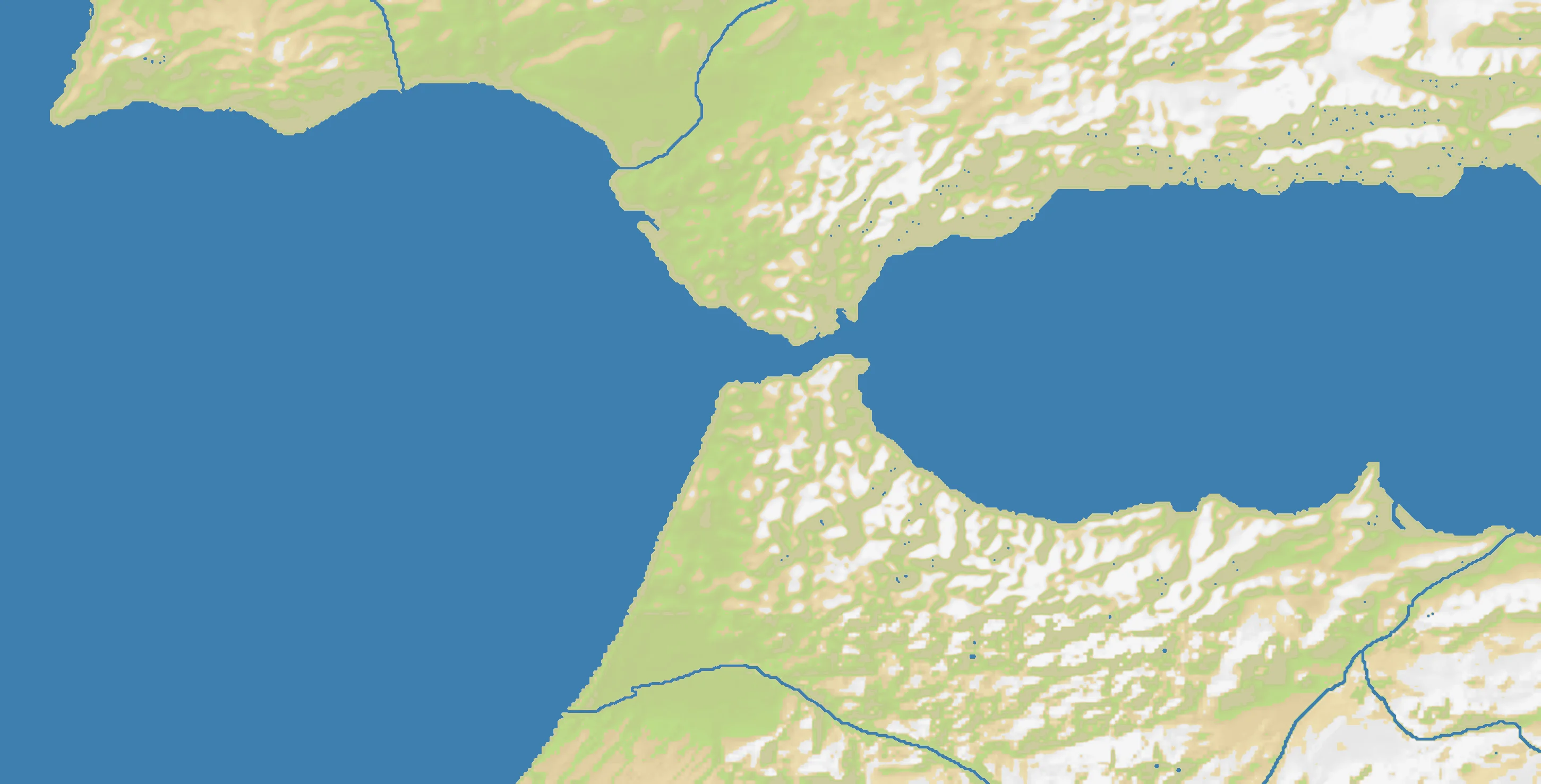
The Strait of Gibraltar is one of the most strategically loaded pieces of water on Earth: a 14-kilometer-wide channel between Europe and Africa that connects the Atlantic to the Mediterranean. On its north shore sits the Iberian Peninsula — Spanish Andalusia, with the Rock of Gibraltar as its sentinel. On the south, Morocco’s Rif Mountains rise sharply from the Moroccan coast. The OpenFront map (2900×1476) captures this confrontation at a regional scale, extending west into the Atlantic and east into the Alboran Sea.
At 45.4% land, the map has near-equal land-sea distribution, but the water isn’t open ocean — it’s the strait itself, acting as a dividing channel. The north shore rises into the Sierra Nevada and Andalusian highlands. The south shore has the Atlas foothills. The strait’s narrowness means crossing points are few, chokepoints are severe, and the gap between Europe and Africa is more geographical fact than obstacle.
The History
711 CE — The Umayyad Crossing
Muslim armies from North Africa crossed the strait in 711 and within eight years had conquered most of the Iberian Peninsula. The campaign began at Jebel Tariq — Gibraltar — and reshaped European history for seven centuries, until the Reconquista gradually pushed the frontier back south. The strait was the hinge on which the history of two continents turned.
1704 — British Seizure of Gibraltar
An Anglo-Dutch fleet captured Gibraltar during the War of Spanish Succession. Britain retained it in the 1713 Treaty of Utrecht and has held it ever since — a territorial anomaly that remains contested between Britain and Spain. The Rock’s strategic value is exactly what the OpenFront map makes you feel: whoever holds that narrow point controls everything.
1940–1942 — Hitler’s Missed Opportunity
During World War II, German strategists understood that capturing Gibraltar would close the Mediterranean to Allied shipping. Hitler’s negotiations with Franco failed. The strait stayed open. Historians often cite this as one of the war’s most consequential non-events — the strategic logic is perfectly legible on this map.
The Battlefield
Terrain Overview
The strait is the map’s entire strategic logic. Both shores fight for control of the crossing points, and whoever dominates the narrows can disrupt enemy naval movement between Atlantic and Mediterranean sectors. The high ground on both sides — Gibraltar Rock to the north, the Rif heights to the south — provides defensive positions that are hard to dislodge.
Best Spawns
- Gibraltar / Southern Spain — control the northern chokepoint; access to both Atlantic flank and Mediterranean interior; historically the dominant position
- Morocco coast (Atlantic side) — flanking position with Atlantic access; can threaten the strait from the west
- Eastern Alboran (deeper Mediterranean) — out of the initial strait fight; room to build before joining the central conflict
Avoid
- Interior positions on either shore — you’re giving up the strait control that this map is built around
- Far western Atlantic edge — too far from the decisive theatre, hard to project power back into the strait
Strategic Insights
The map rewards aggressive early positioning at the strait crossing. Allowing an opponent to lock down both shores creates an extremely difficult comeback scenario. The relatively equal land-sea split (45.4/54.6) means both naval and land forces are necessary — you can’t win with only one.
Fun Facts
- The real Strait of Gibraltar is 14 km at its narrowest — narrower than the English Channel, yet it separates two continents
- Gibraltar has been a British Overseas Territory since 1704, making it one of the world’s longest-held military outposts
- The map’s 2900-pixel width makes it one of the widest regional maps, capturing a long east-west slice of the western Mediterranean