Sierpinski
War inside a fractal thought experiment
Nations 9
The Map
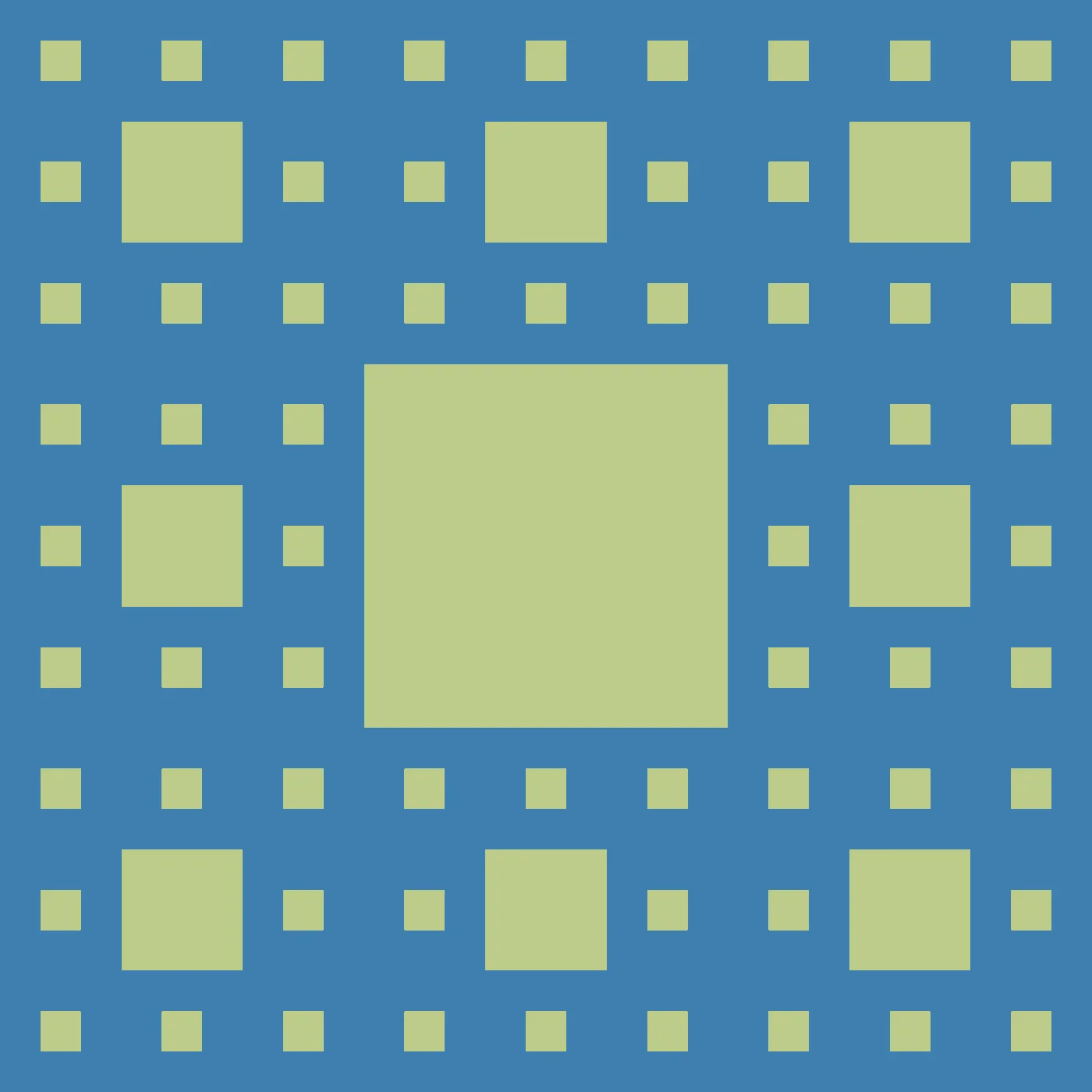
Sierpinski is an arcade map built from pure pattern rather than place. Named for the famous triangle fractal, it turns geometry into terrain: repeating triangular voids carve the map into layers of self-similar land, so the same tactical problem appears at several scales. A route that looks wide from far away may collapse into a funnel up close, while a cluster that seems isolated can reveal hidden continuity through smaller nested shapes.
With 9 nations, 30% land, and a perfectly square 1400×1400 frame, Sierpinski feels like a puzzle that happens to contain armies. There is no natural coastline, no believable mountain range, no regional identity to memorize. Instead, players succeed by reading pattern density, spotting recursive chokepoints, and understanding how the fractal eats mobility. On this map, terrain awareness is not a bonus skill; it is the whole game.
The Battlefield
Terrain Overview
The land network is fragmented by triangular absences that repeat from large sectors down to small local pockets. This creates misleading fronts: one border may look open but reduce to a few tiny bridges, while another appears narrow yet branches into several follow-up lanes. Because the geometry repeats, the map rewards players who can recognize familiar shapes quickly and reuse the same strategic logic at different scales.
Best Spawns
- Broad triangle bases — Larger starting wedges usually provide cleaner early expansion and more forgiving local geometry.
- Second-ring positions near multiple small bridges — These starts can convert pattern knowledge into flexible attack timing once the opening settles.
- Corners of major triangular sectors — Strong if you want defensible fronts and predictable approach angles.
Avoid
- Thin central connectors — They look influential, but they are often fragile, overexposed, and easy to sever.
- Tiny fractured pockets — Starting in heavily perforated terrain can leave you spending too much effort just making your land coherent.
- Ignoring scale changes — A plan that works on a large triangle can fail instantly when a smaller nested gap disrupts reinforcement flow.
Strategic Insights
The key to Sierpinski is to think in templates instead of territories. Once you identify which triangles serve as anchors, which gaps are dead space, and which little bridges actually control an entire branch, the map becomes legible. Until then, it feels cursed. Strong players do not just expand here—they simplify the fractal, turning a beautiful mathematical mess into a few dependable lanes they can dominate.
Fun Facts
- Sierpinski has only 30% land, making it nearly as water-light as Passage in total playable ground even though one is a corridor and the other is a square fractal.
- Its 9 nations put it between the intimate tournament layouts and the full 16-player fantasy brawls of Passage and Pluto.
- Among these ten maps, Sierpinski is the most abstract by far: TheBox removes oceans, but Sierpinski removes geography itself.