San Francisco
The bay decides who survives
Nations 21

The Geography
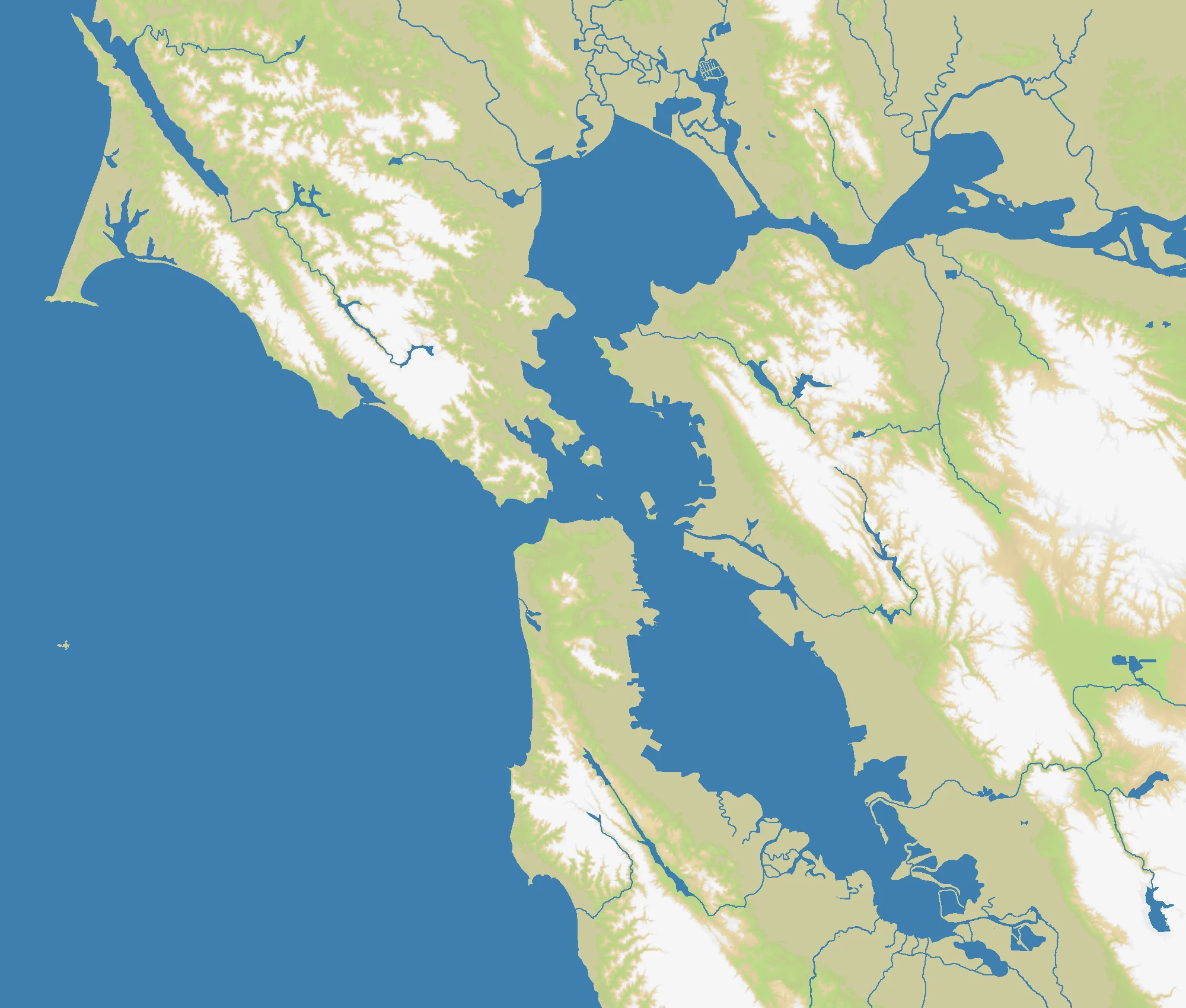
The San Francisco Bay Area is built around water. San Francisco sits on the tip of a peninsula between the Pacific Ocean and the bay; Marin County rises to the north beyond the Golden Gate; the East Bay stretches along the inland shore through Oakland and Berkeley; and the southern reaches narrow toward Silicon Valley and San Jose. The bay itself is a drowned river valley, a broad inland sea connected to the Pacific by one of the world’s most famous straits.
That geography makes the region naturally fragmented. Hills, marshes, peninsulas, and bridges divide short distances into separate operational zones. On a 2000×1700 map with 56% land, OpenFront captures that balance well: there is plenty of territory to contest, but the bay is too large to ignore and too central to safely concede. Unlike a river map where water is a border, here water is the center of gravity.
The orientation also matters. The map is wide enough to make the North Bay, East Bay, Peninsula, and South Bay feel distinct, yet compressed enough that no flank stays quiet for long. Twenty-one nations is a high count for such a broken landscape, so the opening phase tends to be sharp, local, and unforgiving.
The History
1849 — Gold Rush Gateway
San Francisco exploded in importance during the California Gold Rush. Its harbor became the main receiving point for migrants, supplies, and capital rushing toward the Sierra foothills, turning a small settlement into the commercial capital of the West Coast.
1906 — Earthquake and Fire
The 1906 earthquake and the fires that followed devastated San Francisco. Yet the city rebuilt quickly, and the disaster reshaped regional planning, engineering, and the relationship between the city core and the wider bay communities.
1945 — Pacific War Command Hub
During World War II, the Bay Area served as a major shipbuilding, logistics, and embarkation zone for the Pacific theater. Oakland, Richmond, Mare Island, and the port complex helped make the region one of the United States’ key maritime-industrial nodes.
1970s–Present — The Tech Metropolis
As defense industries gave way to computing, software, and venture capital, the bay’s southern and inland edges became the core of Silicon Valley. The modern region is both a port complex and one of the world’s most influential technology clusters.
The Battlefield
Terrain Overview
This map revolves around bay crossings and shoreline control. The San Francisco Peninsula has defensible edges but limited room. Marin is naturally protected by water and hills, yet can become isolated. The East Bay often has the strongest growth potential because it combines a long land corridor with multiple waterfront access points. The South Bay is broad enough to build up, but its distance from the Golden Gate can leave players late to the decisive fight.
The Golden Gate is the map’s emotional and strategic focal point, but not the only one. The narrows between the Peninsula and East Bay, plus the interior shoreline around Oakland and the lower bay, create several smaller contests that decide whether one player can unify the region or whether the battlefield stays fractured.
Best Spawns
- East Bay shoreline — strong land growth, multiple coastal angles, and good access to the central bay.
- South Bay approach — space to expand and enough distance from early chaos to build momentum.
- Marin side of the Golden Gate — naturally defensible with excellent leverage over the bay entrance.
Avoid
- Tiny Peninsula bottlenecks — easy to pressure from sea and land at the same time.
- Overexposed central waterfront starts — strong in theory, but often attacked before they can consolidate.
Strategic Insights
The Bay Area rewards players who understand interior lines. If you can move quickly across one shore while forcing opponents to cross water to reach you, you gain tempo over and over again. Naval control matters less as raw fleet size and more as control of crossings, ferries, and shoreline threat zones.
Do not treat the bay as a moat; treat it as a road. The player who uses it to reposition between fronts usually beats the player who simply defends one side of it. Winning San Francisco often means controlling just enough of the bay to make the rest of the map feel small.
Fun Facts
- San Francisco Bay is roughly 1,600 square miles in total system area when its connected waters and estuaries are included.
- The Golden Gate itself is only about 1 mile wide at its narrowest navigable section, which helps explain its enduring strategic importance.
- During World War II, Richmond shipyards in the East Bay built Liberty and Victory ships at astonishing speed — sometimes in a matter of days.