Oceania
The Pacific scatters power into islands
Nations 32













The Geography
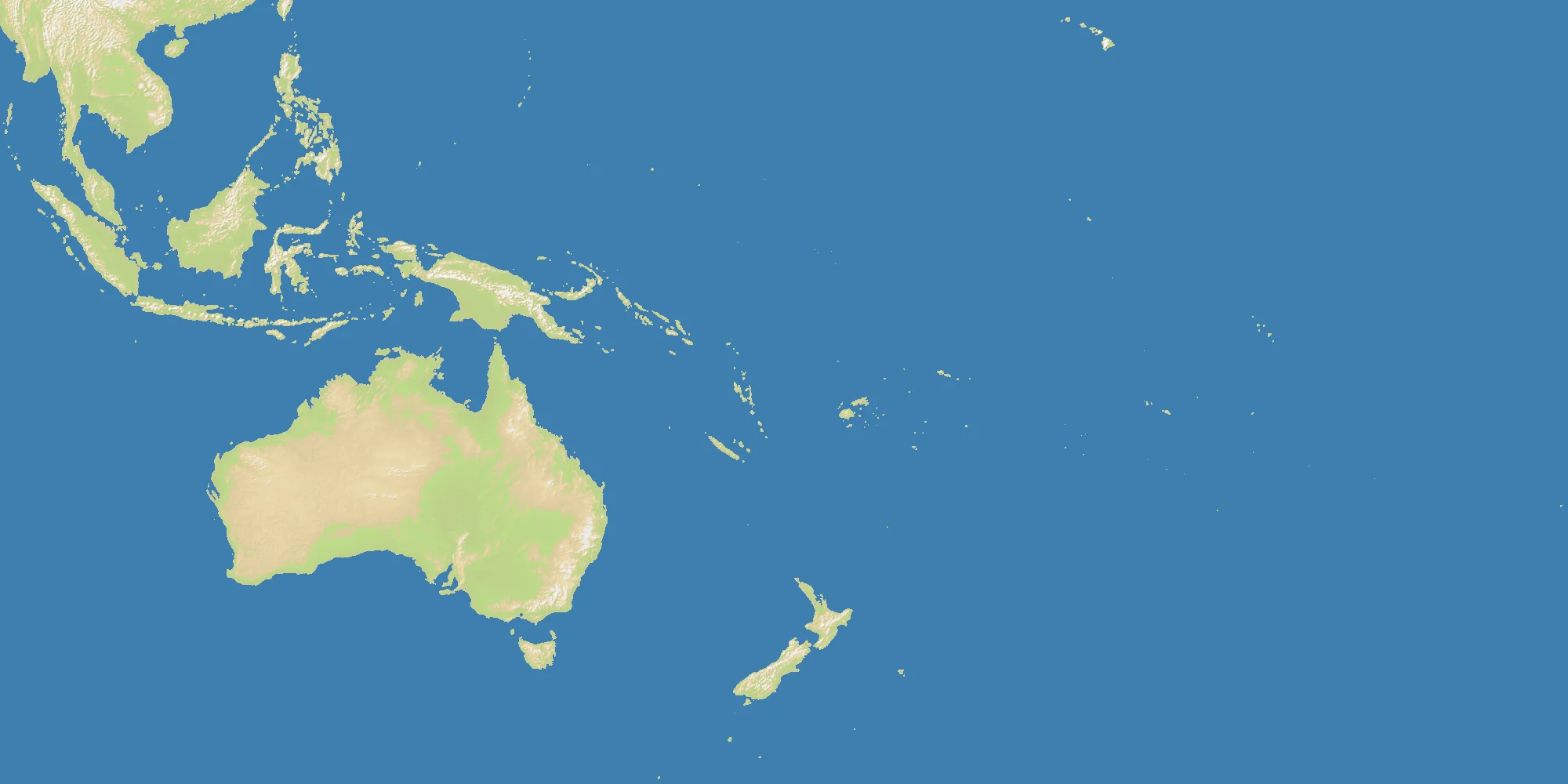
Oceania stretches across the largest ocean on Earth. Australia dominates the southwest as a continental landmass, New Zealand sits far to the southeast, and between them lie thousands of islands spread across Melanesia, Micronesia, and Polynesia. Papua New Guinea, Fiji, Samoa, Tonga, the Solomons, Vanuatu, and countless smaller chains form stepping stones across a region so vast that distance itself becomes the main terrain feature.
This OpenFront version leans fully into that reality. At 2000×1000 with only 10% land, Oceania is the most water-dominant of the continental maps. Thirty-two nations are scattered across a battlefield that is 90% ocean, so no one begins with much room — but everyone begins with a coastline. Australia provides the only major continuous land bloc, while nearly every other start depends on island hopping, sea lanes, and careful fleet timing.
That makes Oceania feel unlike any other continent. Here, the sea is not the edge of the map; it is the map. Land control matters, but maritime reach matters more. A player who thinks only in local terms will get stranded, while a player who thinks in chains of islands can turn the Pacific into a highway.
The History
c. 1200 BCE–1200 CE — Polynesian Navigation
Long before Europeans entered the Pacific, Austronesian and Polynesian navigators crossed immense distances using stars, swells, birds, and memory. Their settlement of islands from Tonga to Hawai’i to Aotearoa/New Zealand remains one of humanity’s greatest achievements in open-ocean exploration.
1521 — Magellan Crosses the Pacific
Ferdinand Magellan’s expedition became the first European voyage to cross the Pacific Ocean. The crossing revealed both the ocean’s scale and the brutal logistics of surviving it — a lesson this map teaches quickly when fleets overextend far from secure bases.
1770s — Cook Charts the Region
James Cook’s voyages mapped large parts of Australia, New Zealand, and the island Pacific for European empires. Those expeditions accelerated colonial expansion, redrew maritime networks, and transformed indigenous worlds across Oceania.
1942–1945 — The Island-Hopping War
World War II made the Pacific islands strategically famous. Campaigns at Guadalcanal, New Guinea, and across Micronesia showed how tiny islands could matter enormously when they sat astride naval and air routes.
The Battlefield
Terrain Overview
Oceania is a naval chessboard. Australia is the one place where sustained land campaigns resemble a normal continental war; almost everywhere else, movement happens through chains of islands separated by long stretches of water. New Zealand is remote but defensible, Papua New Guinea is rugged and central, and the western Pacific archipelagos create a dense screen of forward positions.
Because 32 nations occupy only 10% land, openings are sharp and often chaotic. Weak island starts can vanish early if they fail to secure nearby stepping stones. Stronger starts are the ones that combine a safe home island with access to multiple outward routes. The player who owns the best chain — not just the biggest island — often controls the pace of the match.
Best Spawns
- Eastern Australia — rare large land base with access north into the islands and south toward New Zealand.
- Papua New Guinea-Solomons corridor — central position on the map’s busiest island chain.
- New Zealand — remote enough to consolidate, yet still able to project once fleets are ready.
Avoid
- Tiny isolated central Pacific islands — little growth, few reinforcements, and easy to seal off.
- Exposed single-hop islands near stronger neighbors — they become springboards for someone else more often than they become empires.
Strategic Insights
In Oceania, fleets are economy. If your navy cannot escort reinforcements from island to island, your empire is only decorative. Secure chain connectivity first: one island behind another, each within support range. A flashy expansion into the far Pacific means nothing if your middle links are weak.
Australia is powerful, but it also attracts attention because everyone can see its value. Smaller island powers win by being faster, not bigger: deny key waypoints, seize chokepoints in the archipelagos, and force continental players to travel the long way around.
Fun Facts
- Oceania covers far more ocean than land; the Pacific alone contains more water than all of Earth’s continents combined in area.
- Australia is the world’s smallest continent but the sixth-largest country by total area.
- Many Pacific island states contribute almost nothing to global carbon emissions yet face some of the world’s highest risks from sea-level rise.