Nile Delta
Fertile floodplain at empire's crossroads
Nations 11
The Geography
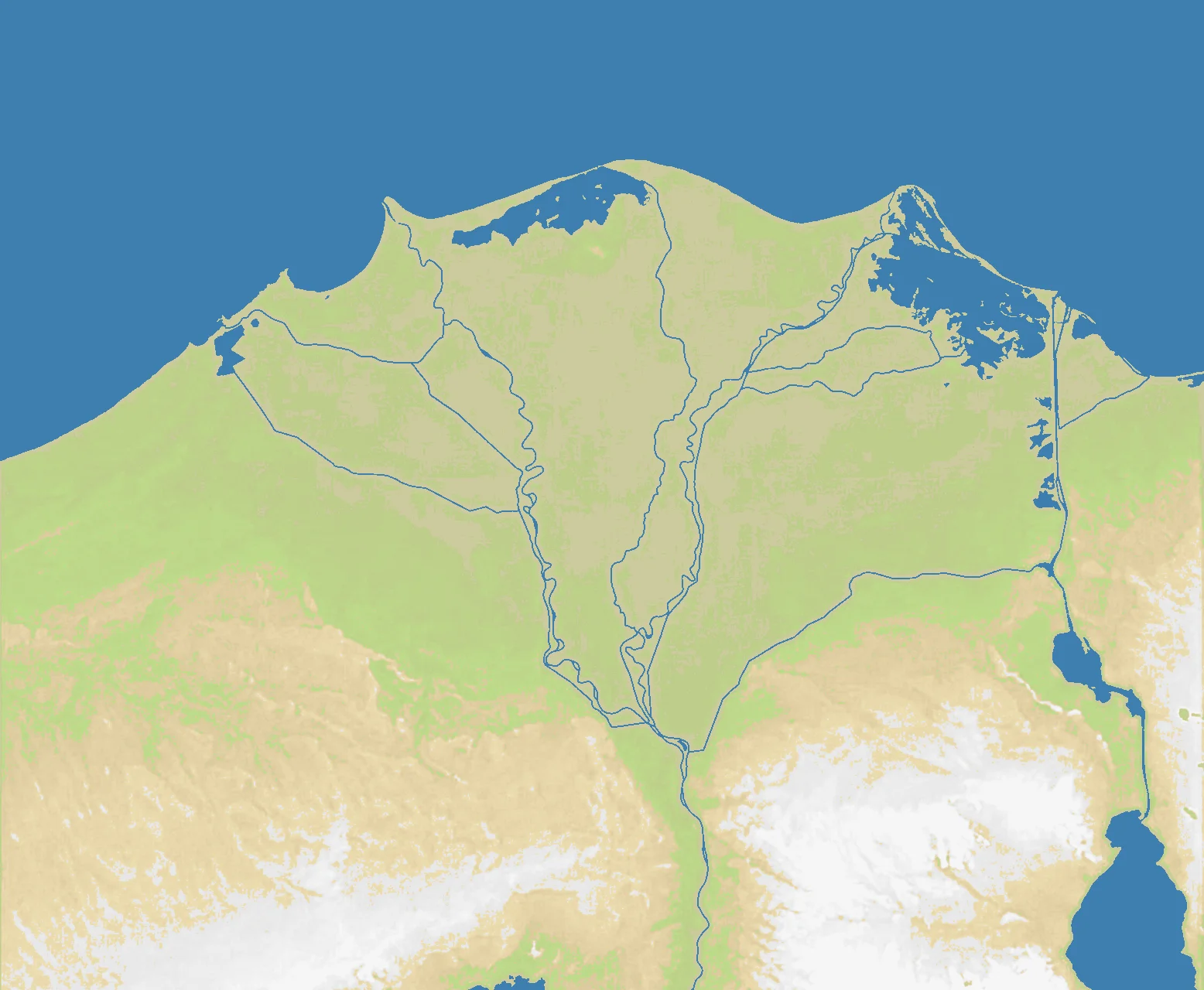
The Nile Delta begins just north of Cairo, where the river divides into distributaries and spreads into a broad triangle before reaching the Mediterranean. It is one of the world’s classic river deltas: flat, fertile, intensely settled, and historically indispensable. Alexandria anchors the western edge, Rosetta and Damietta mark the mouths of major branches, and the whole region sits between Africa, the Levant, and the maritime routes of the eastern Mediterranean.
That fertility is the core of the map’s identity. Although Egypt is mostly desert, the delta is a concentrated patch of productive land made possible by millennia of annual flooding and irrigation. On a 1556×1280 map with 68% land, the Nile Delta plays far more densely than a desert theater would. Branching waterways and marshy edges carve the battlefield into rich compartments, but there is still enough dry ground for aggressive land expansion.
Because only 11 nations share the space, each start has room to breathe — but not for long. The land percentage is high, so players can expand quickly, yet the delta’s channels keep that expansion from becoming trivial. The result feels like a basket of provinces stitched together by riverbanks, canals, and coastal roads.
The History
c. 3000 BCE — Breadbasket of Ancient Egypt
The lower Nile sustained one of the world’s earliest centralized states. Grain from the river valley and delta fed cities, temples, and armies, making this region the agricultural heart of pharaonic Egypt.
331 BCE — Alexandria Founded
Alexander the Great founded Alexandria on the Mediterranean edge of the delta. It became one of the great cities of the ancient world — a port, a seat of learning, and the hinge between Nile agriculture and Mediterranean commerce.
1798 — Napoleon Invades Egypt
Napoleon’s campaign brought the Nile Delta back into European strategic thinking. The French advance, the Battle of the Pyramids farther south, and the naval disaster at Aboukir Bay showed how control of the delta depended on both inland mobility and seaborne access.
1869 — Suez Changes the Region
The opening of the Suez Canal east of the delta transformed northern Egypt into a global transit zone. Even though the canal lies outside the delta proper, it raised the strategic value of every port, rail link, and agricultural center in the region.
The Battlefield
Terrain Overview
The Nile Delta is a land-rich map with just enough water to create real structure. The Mediterranean coast offers naval access and lateral movement, while the branching river network interrupts clean land pushes. Interior positions can expand fast, but they must watch the river crossings; coastal powers can raid and reposition, but they risk getting bottled up away from the delta core.
The western delta around Alexandria tends to feel more open and maritime. The central delta is the busiest and most contested, with short distances between neighbors. The eastern side gains strategic importance because it points toward Sinai and the historic route to Suez, giving it the feel of a gateway rather than a cul-de-sac.
Best Spawns
- Alexandria side of the delta — strong port access and enough room to build before the center fully ignites.
- Central distributary corridor — rich expansion options and the ability to pressure nearly everyone.
- Eastern delta near Damietta — balanced access to coast, river branches, and the map’s overland exit routes.
Avoid
- Low marshy river mouths — exposed to naval harassment and easy to trap behind crossings.
- Overcrowded central chokepoints — powerful if won, disastrous if you fall behind there early.
Strategic Insights
The key to this map is treating rivers as timing tools rather than permanent walls. If you control crossings, you can expand on one bank while delaying attacks from the other. If you ignore them, a rival can split your holdings into isolated pockets. High land percentage means games accelerate quickly; someone who gets the central fan of the delta under control can snowball hard.
Naval play matters most along the coast, but the map is usually won inland. A good coastal fleet should support river and estuary operations, not replace land power. Think like a state built on irrigation: secure the fertile center first, then project outward.
Fun Facts
- The Nile Delta is home to tens of millions of people, making it one of the most densely populated agricultural regions on Earth.
- Alexandria was once famous for the Lighthouse of Alexandria, one of the Seven Wonders of the Ancient World.
- Before major modern dams, the Nile’s annual flood delivered fresh silt that continually renewed the delta’s farmland.