Mars
A cold desert with deep ambitions
Nations 6




The Terrain
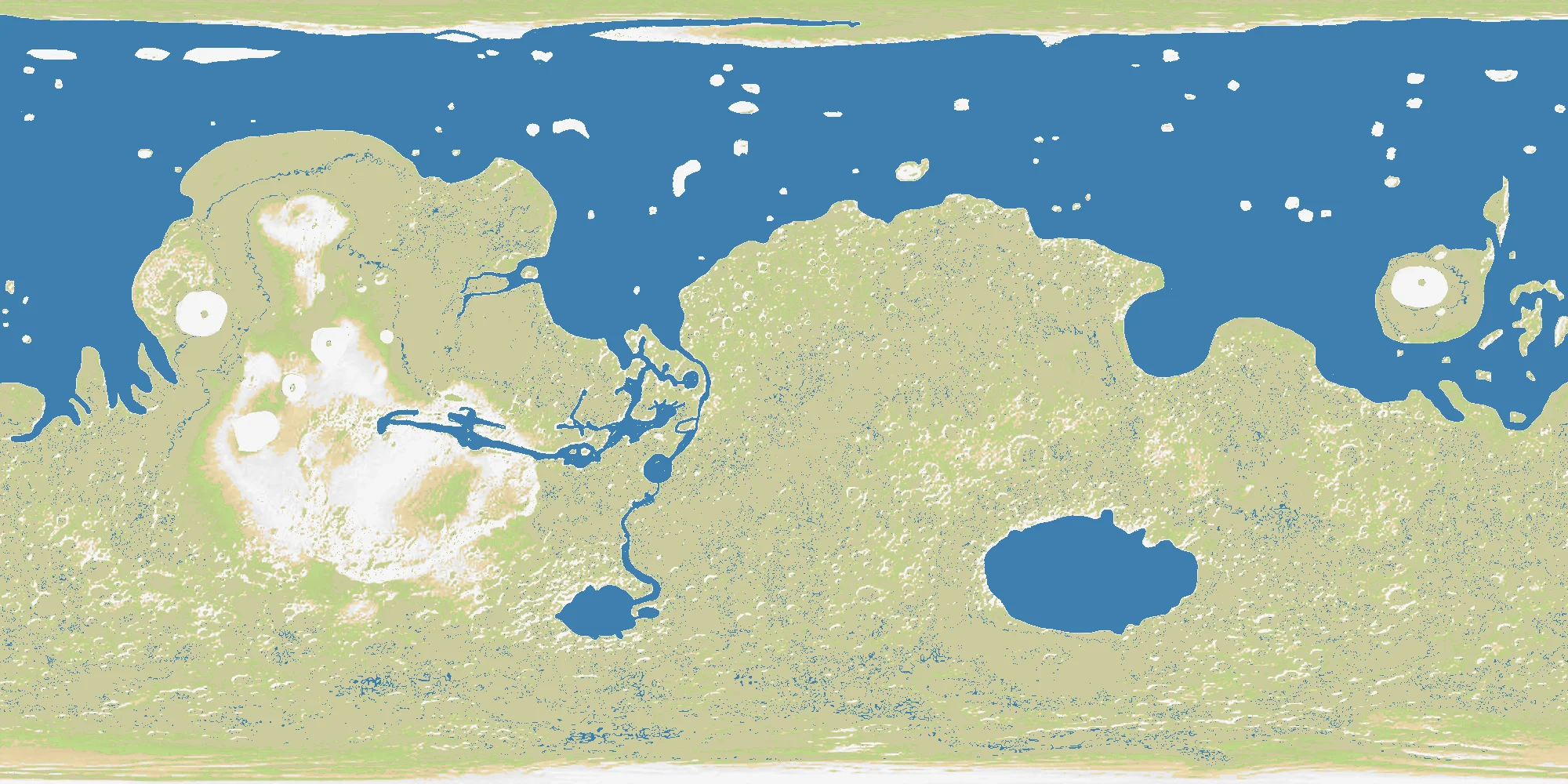
The Mars map (2000×1000) renders a terraformed version of the Red Planet — one where ancient Martian valleys hold liquid water and the planet’s fractured landscape becomes a theatre of conquest. The map imagines what Mars might look like if its northern lowlands (Vastitas Borealis) flooded into a planetary ocean, as some scientists believe happened 3–4 billion years ago. The result: 32.3% water occupying the northern basin, with 67.7% land dominating the southern highlands.
The terrain captures Mars’s real geography in stylized form. The northern hemisphere is smoother — the ancient lava-flooded plains. The southern highlands are more rugged, pocked with impact craters and elevated plateaus. The dramatic elevation difference between the two hemispheres (the Martian dichotomy) is baked into the terrain rendering.
The Science
Mars is the most Earth-like planet in the solar system — and the most studied candidate for human settlement. Its surface preserves the story of a world that may once have been warm, wet, and potentially habitable. The Tharsis plateau hosts the solar system’s largest volcanoes: Olympus Mons rises 21 km above the mean surface level, nearly three times the height of Everest. Valles Marineris, a canyon system stretching 4,000 km, would cross the entire continental United States.
The six nations on the Mars map are drawn from real and historical space programs: NASA, ESA, ROSCOSMOS (Soviet/Russian), ISRO (India), CNSA (China), and the private sector. Their spawn positions echo the geopolitical competition for Mars that is, in 2026, actively underway — no longer science fiction.
The Battlefield
Terrain Overview
Mars is a land-dominant map (67.7% land) with a narrow northern sea. The southern highlands form the bulk of the territorial contest. The division between the smooth northern lowlands and the rugged southern terrain creates a natural front line — whoever controls the highland edge overlooking the northern basin has a significant tactical advantage.
Best Spawns
- Tharsis Plateau region (west-center) — the game’s analog for Mars’s volcanic highlands; elevated terrain, defensible, central expansion routes
- Arabia Terra (east-center highlands) — large territory, multiple expansion directions, away from the initial north-south sea conflict
- Hellas Basin area (south) — a huge impact crater basin that creates distinct terrain; isolated enough to build before joining the main conflict
Avoid
- Far northern sea edge — limited land, naval pressure from multiple directions, hemmed in by the ocean
- Narrow peninsula positions — few neighbors early means slow expansion; then you’re fighting a multi-front war from a small base
Strategic Insights
The 32.3% water in the north acts as a natural barrier between northern and southern spawn zones — early naval control of those waters can lock an opponent to one hemisphere. The low nation count (6) means each player controls enormous territories and the game moves at a more deliberate pace than high-nation maps.
Fun Facts
- Olympus Mons, if placed on Earth, would cover France
- Mars’s thin atmosphere (1% of Earth’s pressure) would make terraforming the single largest engineering project in human history — estimated to take thousands of years
- The map’s 6 nations reflects the six current major spacefaring powers actually competing to reach Mars