Japan
An empire of islands and sea lanes
Nations 12
The Geography
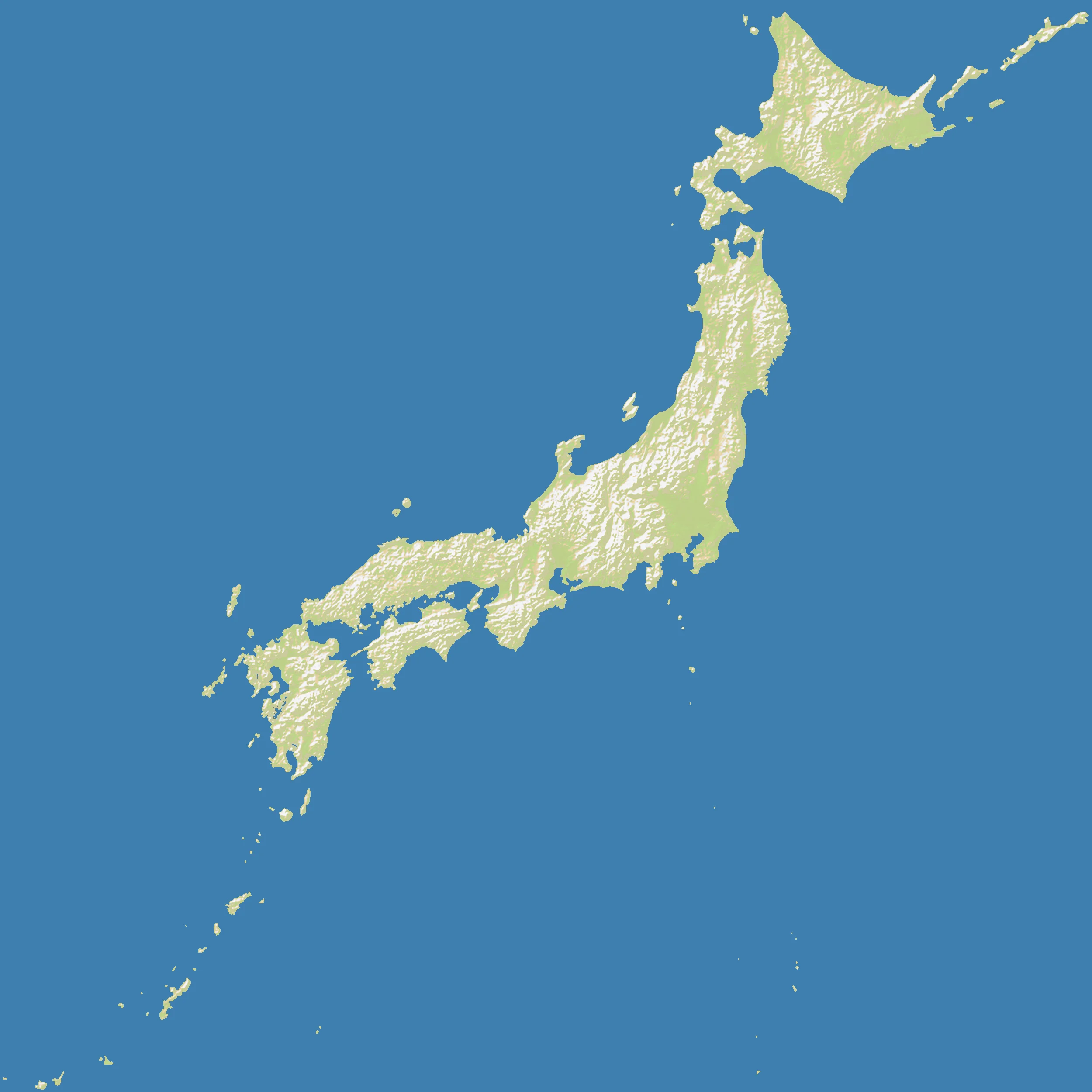
Japan is an archipelago stretched along the western Pacific like a curved defensive wall. The four main islands — Hokkaido, Honshu, Shikoku, and Kyushu — are joined by narrower seas and straits, with hundreds of smaller islands extending the chain southward. On the OpenFront Japan map (2500×2500), only 8% is land and 92% is water, making it the second most ocean-heavy real-geography map after Hawaii.
The islands are mountainous, heavily indented, and broken by interior ranges that historically forced settlement toward coastal plains. That means Japan’s real geography is less about one continuous landmass and more about connected maritime basins: the Seto Inland Sea, the Tsugaru Strait, the approaches to Tokyo Bay, and the western gateways toward Korea and China.
In gameplay terms, that creates a map where the sea is not background terrain but the main road network. Every island can become a fortress, every strait a tollgate, and every landing a potential regime change.
The History
1185 — The Samurai State Emerges
After the Genpei War, Minamoto no Yoritomo established the Kamakura shogunate and shifted power from the imperial court to warrior elites. Japan’s political order became defined by regional military control backed by maritime and overland connections between provinces.
1600 — Sekigahara and Tokugawa Rule
Tokugawa Ieyasu’s victory at Sekigahara led to more than 250 years of shogunal rule. The archipelago was politically unified, but the islands and internal barriers still preserved strong regional identities and domain-based power.
1868 — The Meiji Restoration
The shogunate fell and imperial rule was restored, launching rapid industrialization, military modernization, and centralization. Japan transformed from a feudal island state into a modern naval power capable of projecting force across East Asia.
1941–1945 — The Pacific War
Imperial Japan’s expansion collided with the United States and Allied powers in a war defined by island chains, carrier fleets, amphibious assaults, and strategic blockade. The geography that protected Japan also made defeat catastrophic once its maritime lifelines were broken.
The Battlefield
Terrain Overview
Japan is an island-hopping map where territorial control depends on crossing water repeatedly. Even the biggest island, Honshu, is broken enough by distance and terrain that controlling it does not automatically secure the archipelago.
Best Spawns
- Central Honshu — best mix of population center, coast access, and reach toward both eastern and western theaters
- Kyushu — strong naval projection into the southwest approaches and solid internal room to build
- Seto Inland Sea region — dense cluster of coasts and crossings that rewards active fleet play
Avoid
- Remote northern or southern outliers — too much distance, too little immediate growth, and easy to isolate
- Single-strait bottlenecks — powerful if held, disastrous if the crossing is lost
Strategic Insights
On Japan, fleets are infrastructure. Land is scarce and valuable, but the side that sequences island hops efficiently will usually beat the side that simply hoards provinces on one island.
Fun Facts
- About 70% of Japan is mountainous, which is why so much of its population is concentrated on narrow coastal plains
- The Seto Inland Sea has long functioned as Japan’s protected internal maritime highway
- Japan’s 92% water share makes it one of the most naval-first maps in the entire atlas