Iceland
Fire, ice, and the North Atlantic
Nations 8
The Geography
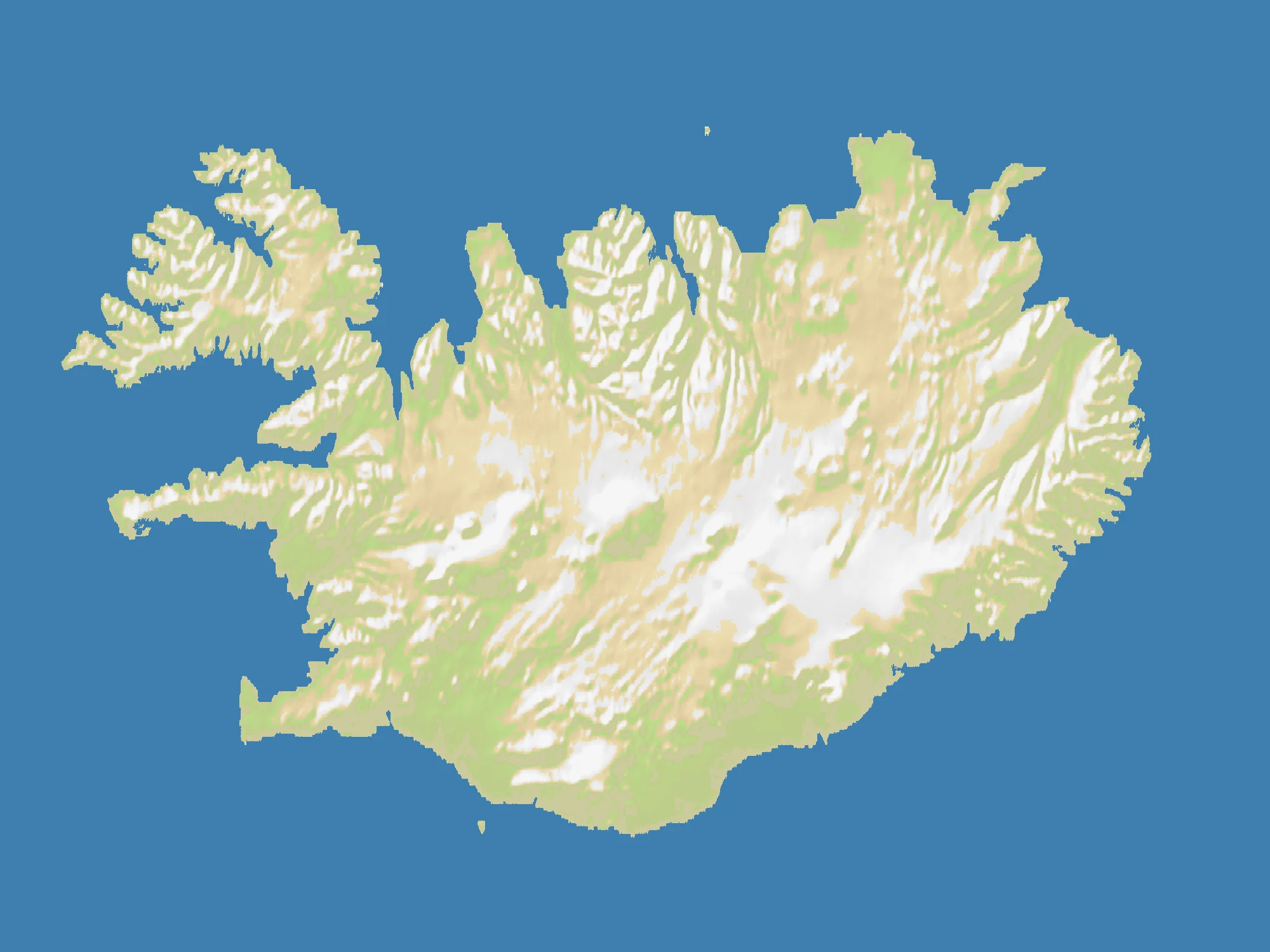
Iceland sits alone in the North Atlantic, straddling both a volcanic hotspot and the Mid-Atlantic Ridge. That double geological accident made it one of the strangest inhabited islands on Earth: glaciers spill down from high interior plateaus while lava fields, geysers, black-sand coasts, and rift valleys fracture the same landscape. On the OpenFront Iceland map (2000×1500), land makes up 37% of the space, leaving 63% as surrounding ocean.
The coastline does most of the strategic work. Iceland’s interior is harsh and historically thinly settled, while the more habitable ring around the coast connects fjords, peninsulas, and fishing harbors. The southwest around Reykjavik is the natural center, but the island’s shape means the north, east, and west can all become self-contained theaters if crossings are contested.
Even though Iceland is a single island, it rarely plays like one solid landmass. Glacial tongues, lava deserts, and long coastal distances break it into segments, creating a battlefield with more texture than its modest size suggests.
The History
c. 870 CE — Norse Settlement Begins
Norse settlers arrived during the Viking Age, with Ingólfr Arnarson traditionally credited as the first permanent settler. Iceland quickly became a frontier society tied to the sea, where coastal access mattered more than interior control.
930 CE — The Althing Is Founded
Iceland established the Althing, one of the world’s oldest continuous parliamentary institutions. In a scattered island society, political unity depended on assembling people from far-flung districts rather than ruling from a single dense urban core.
1940 — Iceland in World War II
Britain occupied Iceland to keep Germany from using it as a North Atlantic base, and the United States later took over defense duties. The island’s mid-ocean location made it a convoy shield, air ferry point, and anti-submarine platform.
1949 — NATO and the Arctic Frontier
Iceland joined NATO despite having no standing army. Its strategic value came not from manpower but from geography: whoever can operate from Iceland can watch the Greenland-Iceland-UK gap, one of the key choke points of the North Atlantic.
The Battlefield
Terrain Overview
Iceland mixes island warfare with broken land warfare. The coastline invites expansion, but the island’s rough interior and long perimeter make overextension easy.
Best Spawns
- Southwest Iceland — strongest centrality, best access to the island’s most connected coastal routes
- Northern fjord regions — defensible pockets with room to build before committing southward
- Eastern coast — safer early development, with fewer immediate fronts than the southwest
Avoid
- Deep interior starts — poor mobility and awkward reinforcement compared with coast-hugging positions
- Exposed peninsulas in the west — easy to cut off by sea if fleets get loose behind you
Strategic Insights
Iceland rewards hybrid play. Pure land expansion is slower than it looks, but pure naval play can strand you on disconnected coasts; the winning approach usually links coastal marching with selective sea control.
Fun Facts
- Iceland is one of the few countries split by a visible plate boundary running through its territory
- More than 10% of Iceland is covered by glaciers despite its volcanic reputation
- Keflavik’s Cold War air base made the island one of NATO’s most important unsinkable aircraft carriers