Falkland Islands
Cold winds over a fiercely disputed sea
Nations 12

The Geography
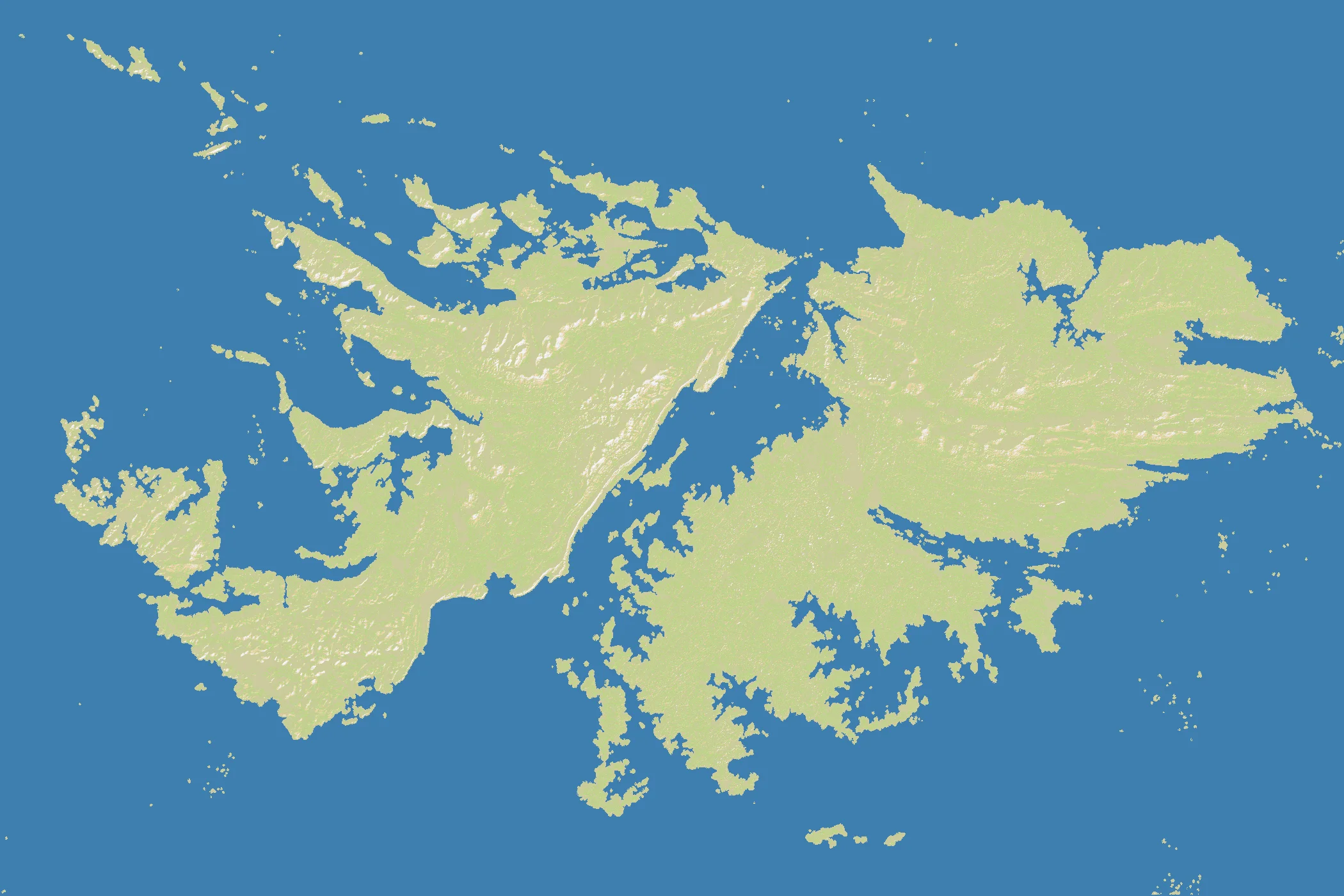
The Falkland Islands lie in the South Atlantic roughly 300 miles east of the Argentine coast, isolated in a broad expanse of cold ocean. The two principal islands — East Falkland and West Falkland — are deeply indented by bays, sounds, and inlets, while smaller surrounding islands fragment the coastline even further. This is not a lush archipelago but a windswept maritime outpost of moorland, low mountains, and exposed anchorages.
On the OpenFront map (2100×1400), only 29% is land. That makes the Falkland Islands one of the most sea-dominated real-geography theaters in the atlas. Land exists as scattered objectives inside a huge operational ocean, so fleets are not optional support units here — they are the backbone of the entire campaign.
Geographic isolation is the map’s defining psychological feature. There is no nearby continental hinterland to retreat into, no deep interior to consolidate. Everything happens on exposed coasts, contested crossings, and lonely islands where a single lost naval battle can suddenly make an entire flank indefensible.
The History
1764 — Permanent Settlement Begins
French settlers established Port Louis, beginning the modern contested history of the islands. British and Spanish claims followed, and the Falklands quickly became a symbol of strategic presence as much as of settlement.
1833 — Britain Reasserts Control
The United Kingdom reestablished administration over the islands, and the Falklands remained under British rule thereafter. Argentina never accepted this as final, leaving sovereignty unresolved in diplomatic memory even when the islands seemed militarily remote.
1914 — Battle of the Falkland Islands
During World War I, a British squadron defeated a German East Asia Squadron near the islands. The clash showed that even this remote corner of the South Atlantic could matter when long-range naval routes were at stake.
1982 — The Falklands War
Argentina invaded the islands in April 1982, triggering a British task force response from across the Atlantic. The war was short, brutal, and overwhelmingly shaped by distance, sea control, and the difficulty of projecting power into a cold remote theater.
The Battlefield
Terrain Overview
Falkland Islands is a naval supremacy map with scattered land prizes. The low land percentage means the sea decides where battles happen, while the broken coastline produces many landing possibilities but few secure rear areas. Once control of the surrounding water shifts, island positions can collapse very quickly.
Best Spawns
- East Falkland central coast — access to the largest landmass and the map’s busiest surrounding waters
- West Falkland / central channel approaches — strong interception position between major islands
- Outer island anchors near the main cluster — room to maneuver while still threatening the core islands
Avoid
- Far peripheral islets — defensible for a moment, but too disconnected to influence the decisive fight
- Narrow exposed coastal pockets — easy to land behind and hard to reinforce after a naval loss
Strategic Insights
The central question on Falkland Islands is not whether to invest in fleets, but how quickly you can convert naval control into irreversible island control. Passive play is dangerous because isolated holdings become liabilities the moment an opponent wins a sea lane. Compared with more balanced maps, this one behaves almost like an amphibious chessboard: mobility first, occupation second.
Fun Facts
- At 29% land, Falkland Islands matches Giant World Map’s global land ratio almost exactly, but compresses that imbalance into a tiny regional war zone
- Its defining historical event, the 1982 Falklands War, is one of the most direct real-world parallels to OpenFront’s naval logistics gameplay
- Despite having 12 nations like Bosphorus Straits, Falkland Islands feels completely different: open ocean maneuver instead of claustrophobic chokepoints