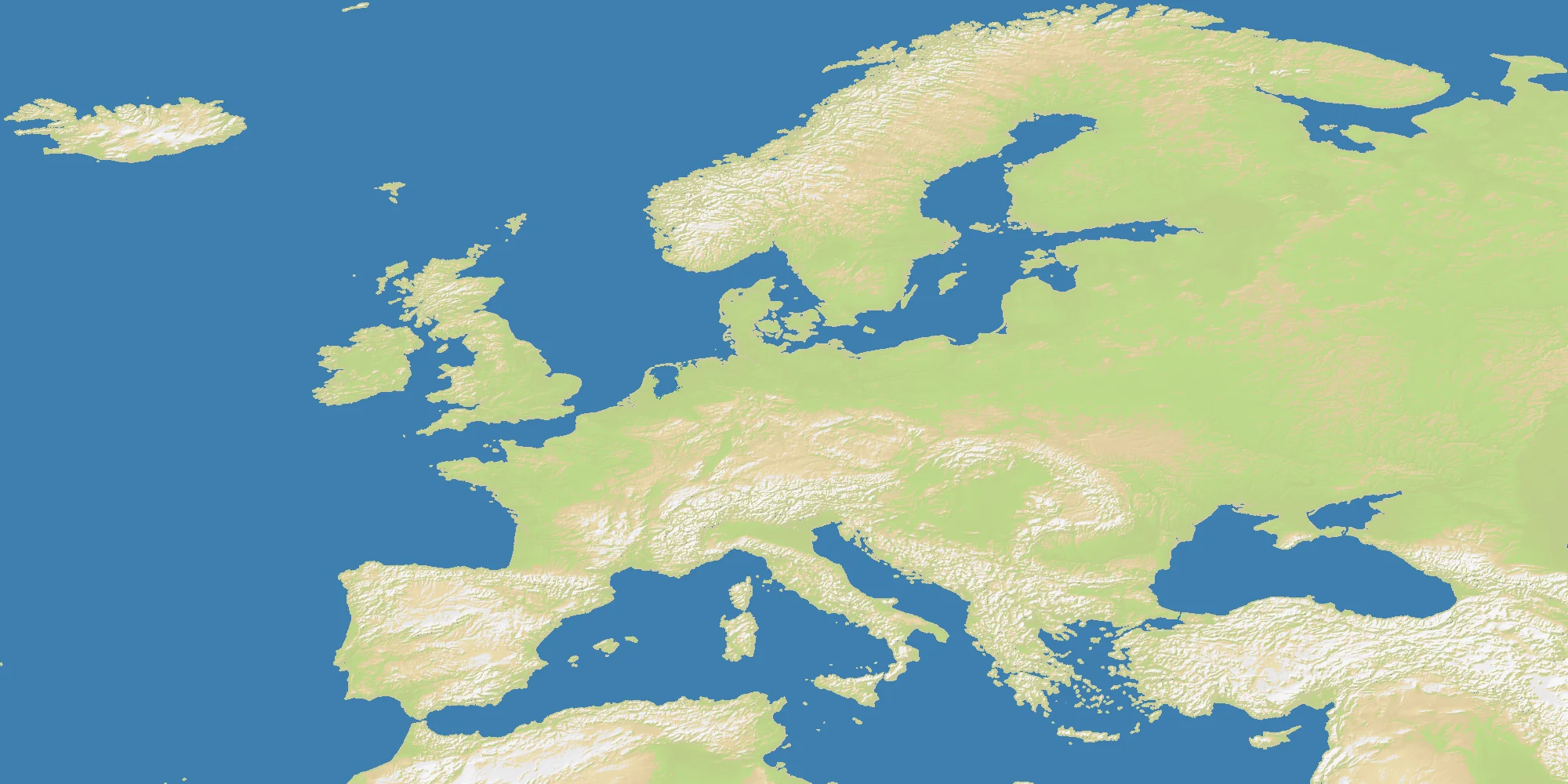
Europe (Classic)
The old continent, pared to essentials
Nations 31



















The Geography
Europe Classic presents the continent in a wide, simplified form that emphasizes its major strategic shapes: the Iberian Peninsula in the southwest, the Italian boot and Balkan knot in the south, the broad North European Plain across the center, and the Scandinavian extension reaching into the north. Seas still matter — especially the Mediterranean, North Sea, Baltic, and Black Sea — but the map reads more cleanly than the denser standard Europe layout.
At 2000×1000 with 50% land, Europe Classic sits almost exactly at equilibrium between land and water. That balance gives it a very different feel from more ocean-dominant theaters such as Britannia Classic or East Asia. There is enough sea to open flanks and reward naval planning, but enough land continuity that continental expansion remains the default path to power.
The classic format also changes the rhythm of the map. With 31 nations instead of the standard Europe’s 49, borders are less cramped and territories are larger, so players get slightly more breathing room before the full continental dogpile begins. Europe is still Europe — crowded, connected, and dangerous — but this version is cleaner, faster to read, and more forgiving of mid-game maneuver.
The History
27 BCE — The Roman Mediterranean
The Roman Empire turned much of southern and western Europe into a single political system connected by roads, ports, and common administration. The continent’s peninsulas and inland seas became corridors of rule rather than barriers, a logic still visible in the map’s structure.
1648 — The Peace of Westphalia
The treaties ending the Thirty Years’ War helped define the modern concept of sovereign states in Europe. On a map as crowded as this one, that legacy matters: Europe became a continent of borders, balances, and constantly shifting alliances.
1815 — The Congress of Vienna
After the Napoleonic Wars, Europe’s powers redrew the political balance to prevent any one state from dominating the continent. The resulting diplomacy reflected the continent’s geography — too interconnected for isolation, too fractured for easy empire.
1945 — Postwar Europe
World War II devastated the continent, then left it divided between rival blocs in the Cold War. Western integration and eastern militarization followed different paths, but both were shaped by Europe’s dense transport networks and short strategic distances.
The Battlefield
Terrain Overview
Europe Classic is a connectivity map. The continent offers more overland routes than almost any other major theater, and the 50% land ratio means most campaigns can expand without immediately requiring naval mastery. Still, coastlines, inland seas, and peninsulas give smart players plenty of opportunities to turn geography into defense.
Best Spawns
- Central Europe edges — access to multiple expansion fronts without being trapped in a peninsula
- Iberia — strong defensive geometry, controllable entry points, and room to build before pushing outward
- Northern Italy / Alpine approaches — premium centrality with natural defensive terrain nearby
Avoid
- Deep central plain starts — maximum opportunity, but also maximum exposure from every direction
- Far southeastern bottlenecks — easy to get boxed in between sea and mountains if neighbors coordinate
Strategic Insights
Europe Classic rewards players who expand efficiently without becoming everyone’s immediate problem. Because the map has fewer nations than standard Europe, early wars can be more decisive: a successful opening conquest creates a genuinely large base. The real trick is transitioning from local advantage to continental balance before the surrounding powers decide you are the next Napoleon.
Fun Facts
- Europe Classic has 31 nations, dramatically fewer than the standard Europe’s 49, which makes openings less chaotic but each loss more consequential
- At 50% land, it is far drier than Britannia Classic (33%) and East Asia (34%), but less land-heavy than Bosphorus Straits (63%)
- The classic map’s 2000×1000 footprint makes it one of the widest continent-scale arenas in the atlas