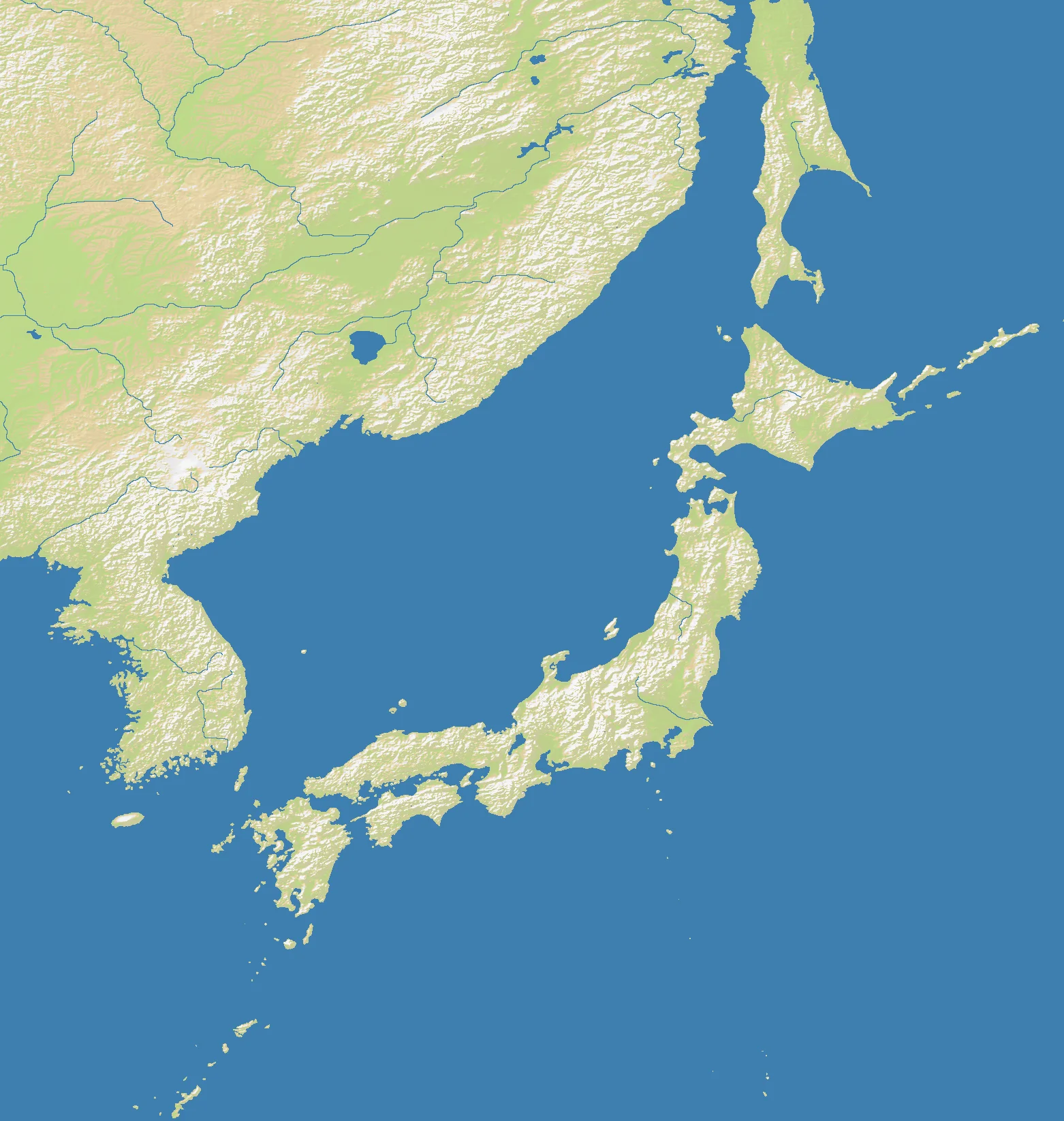
East Asia
Rimlands, islands, and powder-keg seas
Nations 22






The Geography
East Asia is a coastal crescent of peninsulas, archipelagos, shallow seas, and densely populated shorelines. The Korean Peninsula juts south between the Yellow Sea and the Sea of Japan, Japan stretches in an arc along the Pacific edge, and the East China Sea ties the region together through a maze of straits and island chains. Taiwan sits at the hinge between the Chinese coast and the wider western Pacific, giving the entire map a natural set of flashpoints.
On the OpenFront map (1560×1644), only 34% of the surface is land. That makes East Asia one of the more water-driven regional maps despite containing some of the world’s most crowded coasts. Land is concentrated into long, narrow forms rather than broad interiors, so armies advance through corridors while fleets threaten to bypass them.
The result is a battlefield of concentrated coastal tension. Korea is a spearpoint, Japan is a segmented island fortress, and the Chinese littoral provides the largest continuous landmass without ever becoming truly inland. Few positions are comfortable for long; this is a map of amphibious pressure, contested straits, and constant exposure to seaborne counterattacks.
The History
1274 — The First Mongol Invasion of Japan
Kublai Khan’s fleets crossed from the Korean peninsula toward Japan, demonstrating how the seas of East Asia could serve as bridges as well as barriers. Storms and resistance defeated the invasion, but the attempt revealed the strategic unity of this maritime zone.
1894 — The First Sino-Japanese War
Japan’s victory over Qing China marked the rise of a modern naval-industrial power in East Asia. Control of Korea and nearby waters became central to regional power politics, a pattern the map still reflects.
1950 — The Korean War
The Korean Peninsula became one of the Cold War’s most dangerous fault lines when North Korea invaded the South and outside powers intervened. The war froze the peninsula into division, turning this narrow land bridge into one of the world’s most militarized frontiers.
1949–Present — The Taiwan Strait Standoff
The Chinese Civil War ended with the People’s Republic on the mainland and the Republic of China on Taiwan. Since then, the Taiwan Strait has remained one of the most sensitive geopolitical chokepoints on Earth, where short distances make any crisis instantly dangerous.
The Battlefield
Terrain Overview
East Asia is a maritime pressure map with dense coastal land corridors. Peninsulas and island chains create obvious invasion routes, but none are safe because fleets can appear on nearly every flank. The limited land percentage means players who ignore naval mobility often get trapped in linear campaigns.
Best Spawns
- Korean Peninsula south or center — strong access to nearby rivals and excellent leverage over surrounding seas
- Western Japan — defensible island base with expansion routes toward Korea, central Japan, and open water
- Chinese coast opposite Taiwan — largest connected land zone plus immediate influence over a major strait
Avoid
- Far eastern island extremities — safe at first, but too slow to shape the central war
- Narrow peninsula tips — easy to bottle up if an enemy controls the sea behind you
Strategic Insights
The winning habit on East Asia is to combine corridor warfare with naval feints. A strong player pins one rival on land, then uses coastal mobility to open a second front elsewhere before the first fight is resolved. This map is less about owning huge territory and more about owning the tempo of the rim — Korea, Japan, Taiwan, and the Chinese coast are all close enough that mistakes get punished immediately.
Fun Facts
- At 34% land, East Asia sits almost exactly alongside Britannia Classic (33%) as a water-heavy regional theater
- Its core tensions are among the most modern in the atlas, spanning the Mongol invasions, imperial expansion, the Korean War, and the Taiwan Strait standoff
- East Asia is far more fragmented than Bosphorus Straits: both are chokepoint maps, but East Asia stretches conflict across an entire maritime rim rather than one narrow passage