Deglaciated Antarctica
A drowned continent finally shows its bones
Nations 9








The Map
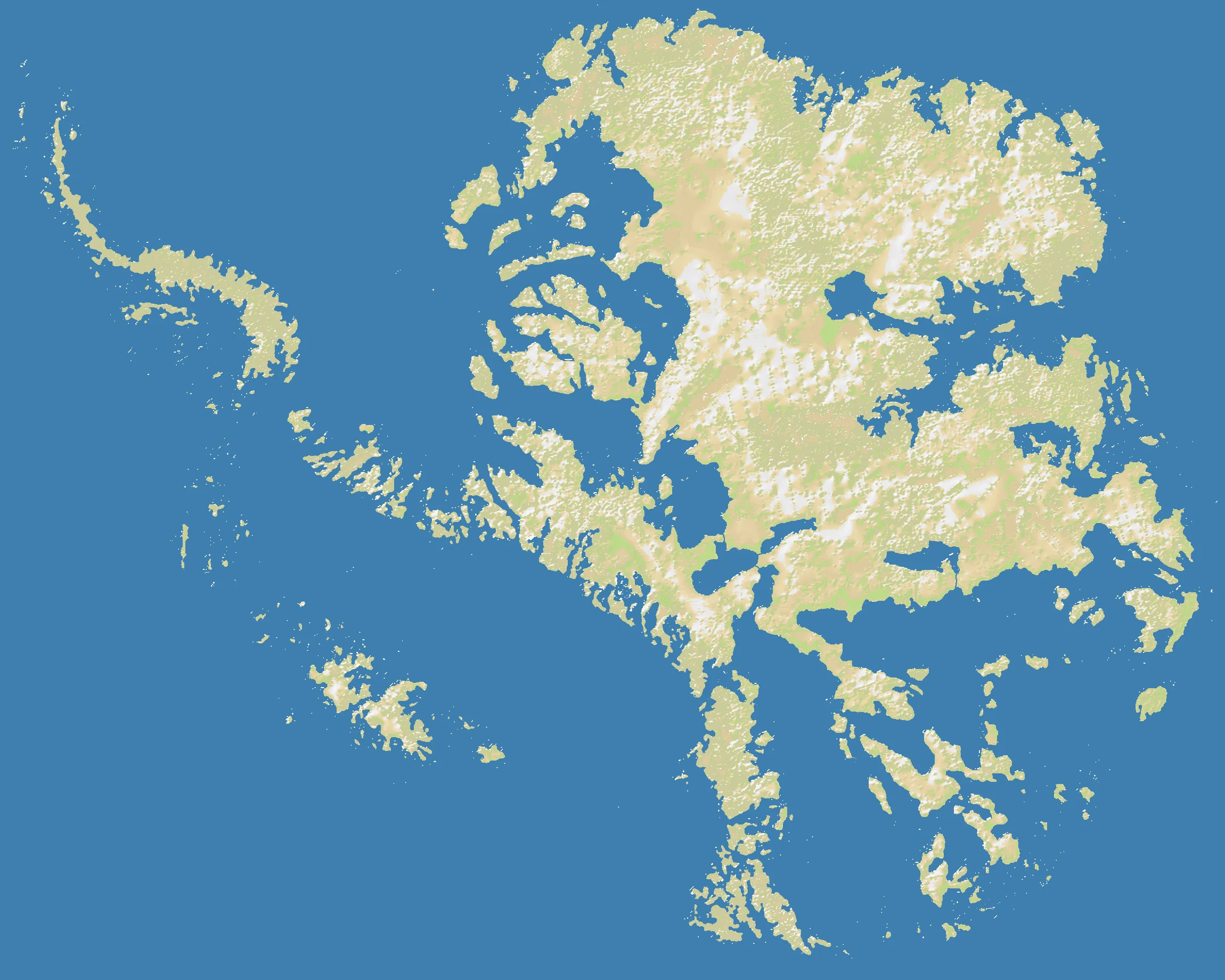
Deglaciated Antarctica imagines the continent after the loss of its ice sheet, revealing the bedrock landscape hidden beneath modern ice. What appears today as a single white mass would actually emerge as a broken, dramatic world: mountain chains, trench-like basins, island arcs, and deep fjords cutting far inland. West Antarctica in particular would fragment into an archipelago-like maze, while East Antarctica would remain larger and more continuous but still deeply scarred by elevation and coastal indentation.
Those stats make for a strange, memorable battlefield. At 2300×1840 and only 26% land, the map is still mostly water even after the ice disappears. With just 9 nations, each player gets meaningful room, but that room is rarely convenient. Land is chunky, separated, and often isolated by cold inland seas. The map plays like a hybrid of polar coastline, shattered island continent, and end-of-the-world expedition.
The Battlefield
Terrain Overview
This is a fragmentation map. The biggest landmasses are valuable because they support growth, but the real challenge is continuity: can you move between your holdings without exposing yourself through narrow maritime chokepoints? West Antarctica’s broken geography invites ambushes and surprise flank routes, while the larger eastern sectors offer safer consolidation at the cost of slower projection.
Because there are only nine nations, the pace is deceptive. Early turns can feel spacious, even lonely, but once fleets establish polar sea lanes the entire map starts to collapse inward. The player who controls one of the few broad, connected land blocks has an obvious economic edge; the player who masters the fjords and channels can offset that with mobility.
Best Spawns
- Large East Antarctic coastal shelf — the closest thing to a stable homeland on the map, with enough land to build before projecting outward.
- Central transantarctic gateway — access to multiple theaters and leverage over crossings between east and west.
- Protected West Antarctic island cluster — weaker on raw land, stronger on naval unpredictability.
Avoid
- Tiny outer islets — visually tempting, strategically miserable, with almost no margin for error.
- Deep enclosed fjord pockets — easy to defend briefly, but terrible for scaling into the midgame.
Strategic Insights
Think of this map as Antarctica stripped of its illusion of unity. The winner is rarely the player with the most coastline; it is the player with the best chain of usable coastline. Secure one coherent land base first, then expand through channels that can be defended by a modest fleet rather than a heroic one.
Do not confuse remoteness with safety. On a 26% land map, every exposed shoreline becomes valuable the moment fleets are active. Polar isolation buys time, but only if you use that time to build a network. Otherwise the thaw just leaves you alone and vulnerable at the edge of the world.
Fun Facts
- If Antarctica’s ice sheet fully melted, global sea level would rise by roughly 58 meters — a planetary change far bigger than the map’s local premise can contain.
- Much of West Antarctica rests on bedrock below sea level, which is why a deglaciated version would likely look far more fragmented than today’s familiar outline.
- The Transantarctic Mountains divide East and West Antarctica for about 3,500 km, making them one of Earth’s great hidden mountain systems.