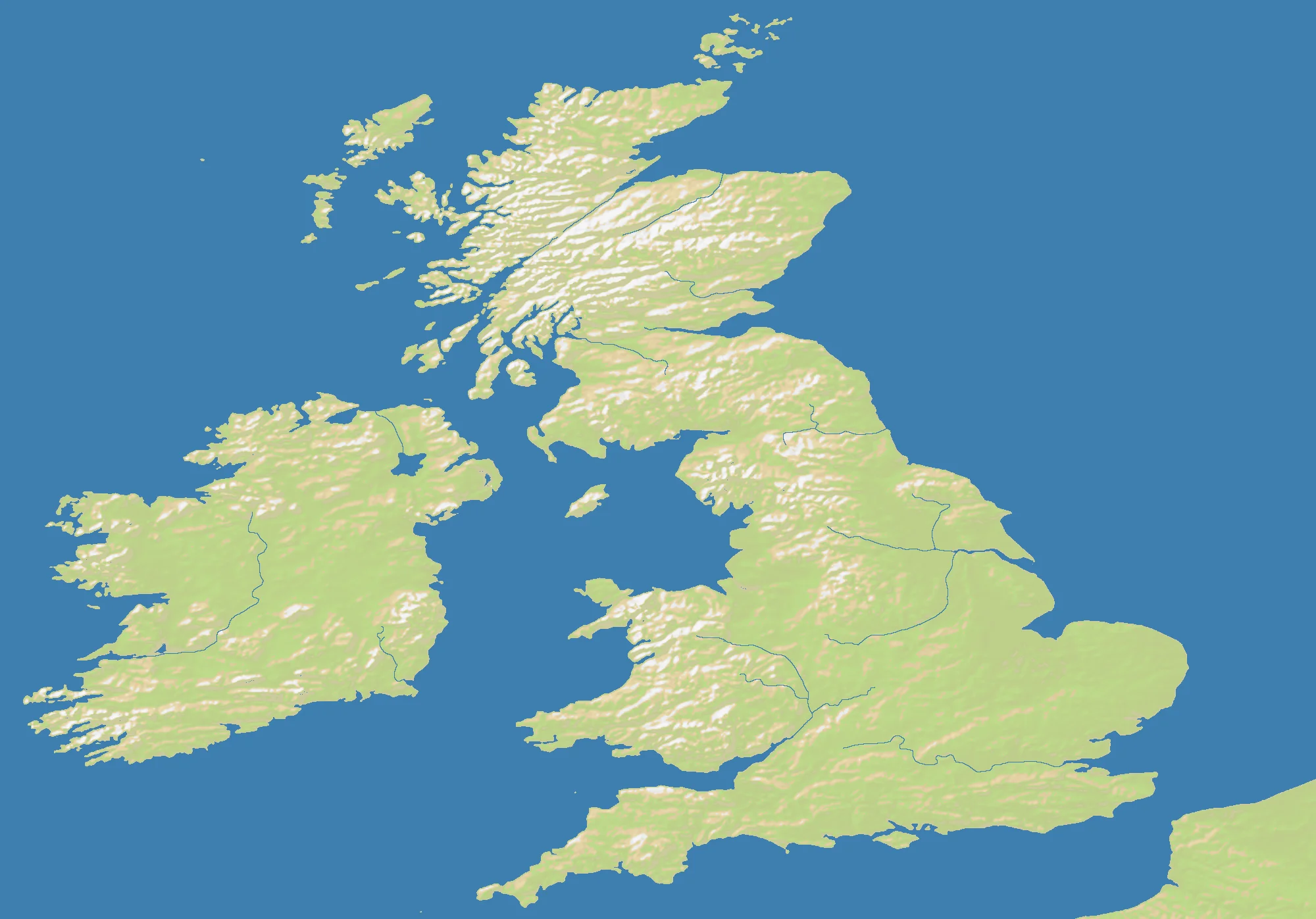
Britannia (Classic)
A streamlined war for the British Isles
Nations 23













The Geography
Britannia Classic covers the British Isles in a broader, flatter format than the standard Britannia map. Great Britain dominates the center, Ireland anchors the western side, and the surrounding waters — the Irish Sea, North Sea, English Channel, and Atlantic approaches — shape every expansion route. The geography is familiar, but the classic presentation emphasizes the overall island system rather than intricate local detail.
At 2000×1396 with 33% land, this is still unmistakably an island theater. Sea space separates the major landmasses, but the oceans do not feel endless; instead, they function as operational lanes connecting Scotland, England, Wales, Ireland, and the outlying coasts. Compared to the taller regional Britannia, the classic version feels more panoramic and more strategically legible at a glance.
That matters in play because island warfare here is about edges. The Scottish Highlands, Welsh peninsulas, Irish interior, and English lowlands all sit inside a tight ring of sea approaches. Coastal control, ferry crossings, and channel access matter more than deep inland maneuver, which gives Britannia Classic a cleaner and more streamlined identity than many continental maps.
The History
43 CE — Roman Britain
The Roman invasion tied southern Britain into a Mediterranean empire, but it never fully erased the geographic logic of the islands. Roman roads, forts, and ports clustered in the more accessible lowlands, while the northern and western fringes remained harder to dominate.
1066 — The Norman Conquest
William the Conqueror crossed the English Channel and won at Hastings, proving that control of the narrow seas could decide the fate of the entire island. From then on, England’s rulers had to think simultaneously about domestic consolidation and overseas approaches.
1588 — The Spanish Armada
Spain’s failed attempt to invade England showed how weather, channel geography, and naval maneuver could combine to defend the British Isles. The surrounding waters were not just moats; they were active battlefields that rewarded mobility and punished overcommitted fleets.
1805 — Trafalgar and Maritime Supremacy
Nelson’s victory at Trafalgar confirmed Britain as the dominant naval power of the age. The islands’ security depended on controlling surrounding seas, a logic that Britannia Classic captures especially well through its emphasis on maritime lanes rather than huge land interiors.
The Battlefield
Terrain Overview
Britannia Classic is a naval-access map disguised as an island land war. The landmasses are large enough to support sustained expansion, but every serious campaign eventually runs through a coast, channel, or crossing. The lower land ratio means overland empires remain vulnerable unless they also secure the water.
Best Spawns
- Eastern England / North Sea coast — rich access to central Britain plus fast routes into Scotland and the Channel
- Irish Sea corridor — flexible position between Britain and Ireland with raid potential in every direction
- Southern Scotland — defensible northern base with expansion paths both south and west
Avoid
- Extreme southwestern peninsulas — defensible, but slow to project force into the map’s core
- Isolated Irish edge starts — safe early, yet easy to outscale if you surrender sea initiative
Strategic Insights
Britannia Classic rewards players who think in rings rather than fronts. Owning the central seas lets you redeploy faster than any purely land-based rival, while overcommitting to one island often leaves another flank exposed. Compared with standard Britannia, the classic version is less intricate and more positional: fewer nations, cleaner shapes, larger territories, and more time for operational planning.
Fun Facts
- Britannia Classic is much broader and shorter than the regional Britannia map, at 2000×1396 versus 1600×2088
- At 33% land, it is slightly less ocean-dominant than East Asia (34%) but far wetter than Europe Classic (50%)
- Its 23 nations make it a mid-density island map: less chaotic than giant continental theaters, but far busier than Faroe Islands with just 6