Black Sea
A nearly closed sea with imperial memories
Nations 9








The Geography
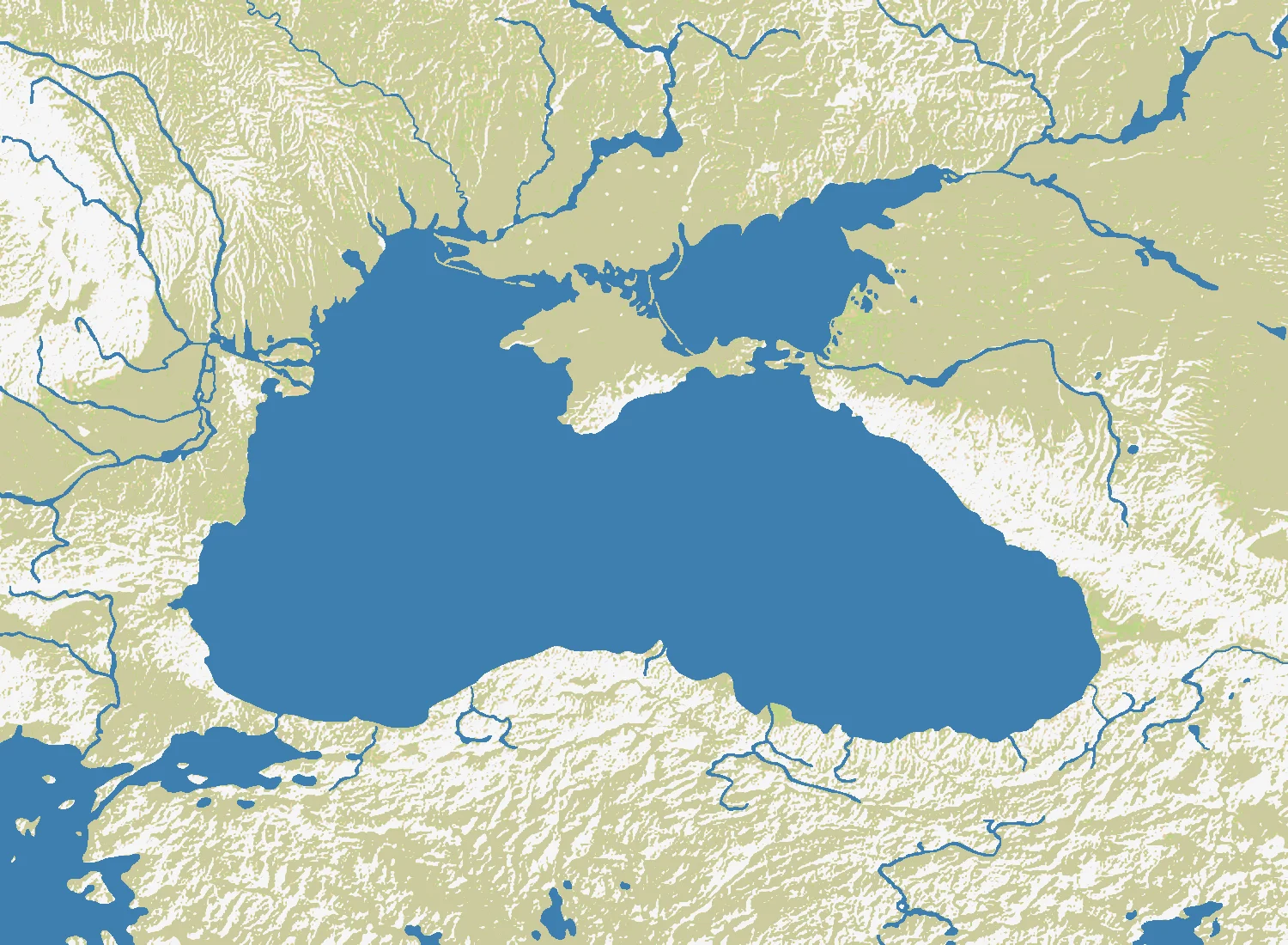
The Black Sea is a maritime basin that feels almost inland. It is enclosed by southeastern Europe, Anatolia, the Caucasus, and the Pontic steppe, with its only true oceanic exit running through the Bosphorus, Sea of Marmara, and Dardanelles. The OpenFront Black Sea map uses a compact 1500×1100 frame that suits this geography: a central sea ringed by coasts that are close enough to fight over immediately.
At 70% land, the map is much more terrestrial than the word “sea” suggests. That reflects reality. The Crimean Peninsula, Danube-facing west, Anatolian south coast, and Caucasian east all create strong land theaters that press inward toward the water. The sea matters because it connects these shores, but it does not overwhelm them; instead, it acts as the central arena around which the land war rotates.
With only 9 nations, Black Sea is relatively measured in pace. There are enough powers to make alliances of convenience impossible, but not enough to turn every shore into instant chaos. You usually have time to decide whether your future empire will be continental, naval, or a hybrid of both.
The History
c. 7th–5th Centuries BCE — Greek Colonies Spread Around the Black Sea
Greek merchants and settlers founded colonies from the western coast to the Crimean and eastern shores. These ports turned the Black Sea from a feared periphery into a connected commercial basin linked to the wider Mediterranean world.
330 CE — Constantinople Becomes the Byzantine Pivot
When Constantine made Byzantium the capital of the Roman Empire’s eastern half, control of the straits became one of the great strategic facts of Eurasian history. The Black Sea was thereafter tied directly to the fortunes of the Byzantine heartland.
1475 — The Ottomans Dominate the Basin
By conquering key ports and subordinating the Crimean Khanate, the Ottoman Empire made the Black Sea an Ottoman lake for centuries. Control of the straits and the southern coast let Istanbul regulate trade, naval access, and regional diplomacy.
1853–1856 — The Crimean War Internationalizes the Region
Russia’s attempt to expand influence triggered intervention by Britain, France, and the Ottoman Empire, turning the Black Sea into the center of a major European war. It proved that this enclosed basin could destabilize the continent far beyond its shores.
The Battlefield
Terrain Overview
Black Sea is a ring fight. The coasts are close, the central water is useful but not dominant, and the peninsula geometry matters constantly. Crimea is the obvious strategic prize because it juts into the center, while the Bosphorus-facing southwest and the Caucasian east control access between land theaters.
Best Spawns
- Crimea / north-central coast — central leverage over the basin and quick pressure on multiple shores
- Western Black Sea / Danube approaches — strong land growth plus access to the sea’s western arc
- Southern Anatolian or Bosphorus-side coast — excellent control over southern movement and potential maritime reach across the basin
Avoid
- Far eastern coastal corners — defensible but easier to isolate if rivals control Crimea and the western basin
- Narrow peninsula tips without hinterland — early tactical value, poor long-term depth
Strategic Insights
Black Sea rewards balance. Because the map is 70% land, a pure fleet-first mindset is usually too narrow, but ignoring the sea is equally dangerous because it shortens distances between hostile coasts. The strongest players use the water as a connector for a land empire: secure a coast, build inland depth, then strike across the basin where opponents think distance still protects them.
Fun Facts
- Despite its name, Black Sea is 70% land, making it much more continental in feel than naval maps like Aegean
- Crimea has been strategically central for more than two thousand years, and the map reflects that by placing it near the heart of the action
- The real Black Sea has only one route to the Mediterranean through the Turkish straits, which is why control of the southwest corner has mattered for empires from Byzantium to today