Baikal
Siberia's inland sea and frozen frontier
Nations 11

The Geography
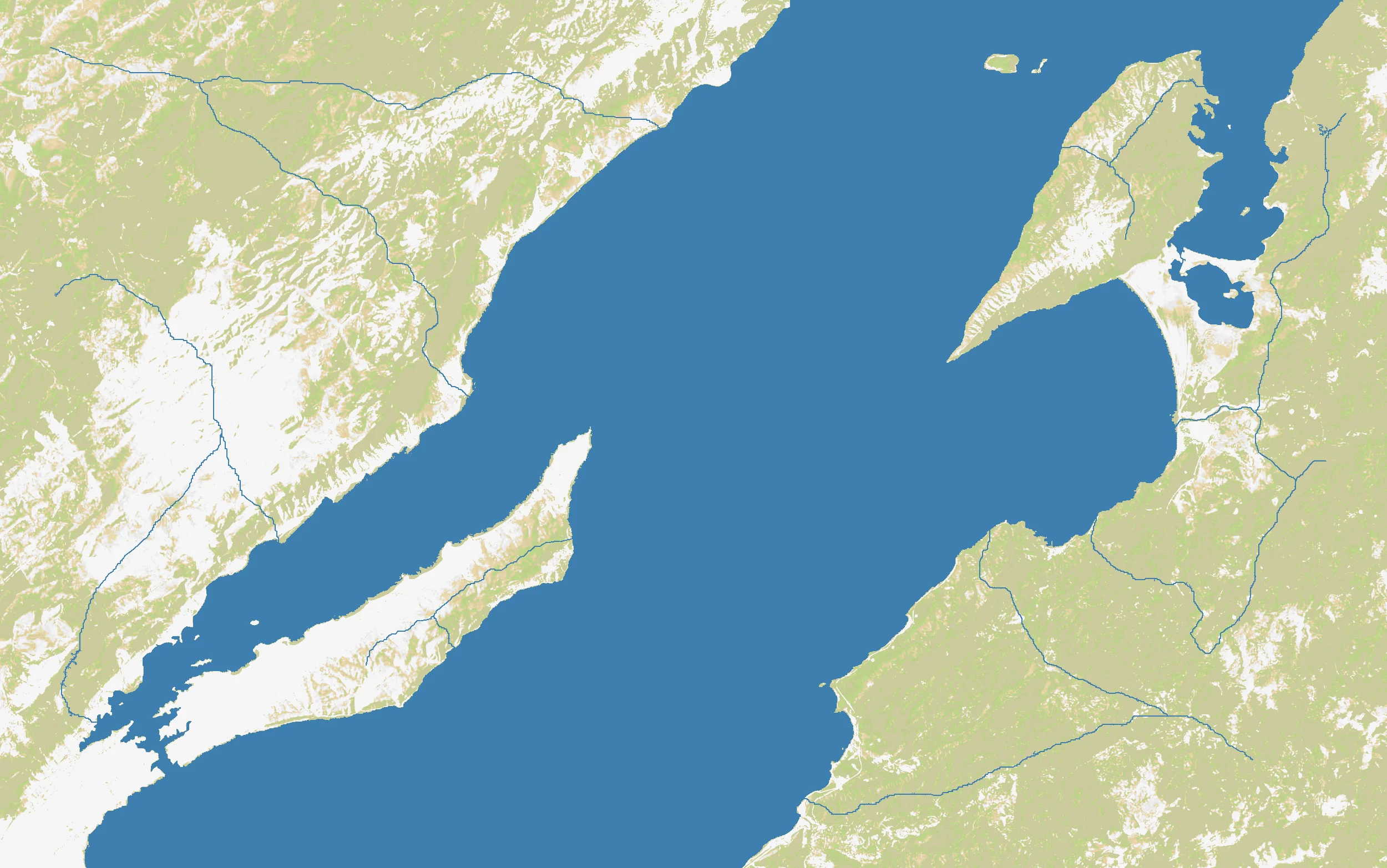
Lake Baikal sits in southern Siberia like a crack in the earth filled with fresh water. It is the deepest lake on Earth and holds more liquid fresh water by volume than any other lake, contained within an ancient rift valley bordered by mountain systems and taiga. The OpenFront Baikal map frames this landscape at 2500×1564, large enough to show the long crescent of the lake, the surrounding uplands, and the wider Siberian approaches that make Baikal more than a single body of water.
At 56% land, Baikal is slightly land-dominant but still strongly shaped by water. The lake itself acts like a gigantic inland barrier: you can move around it, across selected approaches, or use its edges as anchors, but you cannot ignore it. Southern corridors toward Mongolia and the Transbaikal region are more open, while the northern and eastern shores feel more remote and rugged.
With 11 nations, the map lands in a sweet spot between crowded brawls and slow continental build-ups. There is enough room to establish a regional base, but Baikal’s shape forces contact. Whoever controls the southern shore and the passageways around the lake usually controls the tempo of the match.
The History
1643 — Russians Reach Lake Baikal
Cossack and explorer Kurbat Ivanov is often credited as one of the first Russians to document Baikal directly during Moscow’s eastward expansion. His arrival marked the incorporation of this remote region into the growing Russian imperial frontier.
1890s–1900s — The Trans-Siberian Railway Crosses the Region
The construction of the Trans-Siberian Railway transformed Baikal from a distant frontier into a strategic corridor linking European Russia to the Pacific. Even before the full circum-Baikal line was finished, ferries, rails, and engineering works around the lake gave the region outsized logistical importance.
1930s–1950s — Gulag Labor Shapes the Siberian Interior
The wider Baikal region was tied to the Soviet camp system, resource extraction, and forced labor projects across eastern Siberia. In Soviet strategic thinking, remote space was not emptiness but infrastructure, imprisonment, and industrial potential.
1996 — Baikal Becomes a UNESCO World Heritage Site
International recognition of Baikal’s ecological uniqueness highlighted a different kind of strategic value: biodiversity, fresh water, and environmental protection. The lake is not only a frontier landmark but one of the planet’s most extraordinary natural reservoirs.
The Battlefield
Terrain Overview
Baikal’s lake geometry creates a natural split in the map. The southern arc is the busiest zone because it combines workable land, transport-style corridors, and routes into neighboring territories. Northern positions are more secluded, but they can become traps if someone else locks down the southern belt first.
Best Spawns
- Southwestern shore / Irkutsk side — central access, multiple route options, and control over one of the lake’s busiest approaches
- Southeastern / Transbaikal corridor — strong expansion line toward Mongolia-facing land and the eastern shore network
- Western inland uplands — slightly safer staging ground with room to develop before contesting the lake directly
Avoid
- Far northern shore — isolated, slow to expand, and too dependent on long rotations around the lake
- Narrow lake-edge cul-de-sacs — attractive defensively, but easy to pin if an enemy controls the opposite shore
Strategic Insights
Baikal punishes players who treat the lake as scenery. It is the map. Your job is either to dominate the southern circulation routes or to build a force powerful enough to break them. Because the map is 56% land, you can still assemble large territorial blocs, but whoever owns mobility around the lake usually gets to decide where the real war happens.
Fun Facts
- Lake Baikal contains roughly one-fifth of the world’s unfrozen surface fresh water, which gives this map a natural centerpiece unlike anything else in the regional pool
- Baikal’s 11-nation setup is much calmer than Arctic’s 44, but the lake’s shape creates just as many strategic headaches
- It is one of the few maps where an inland body of water matters almost as much as an ocean would on a maritime map