Asia
The largest continent, compressed into empires
Nations 25




















The Geography
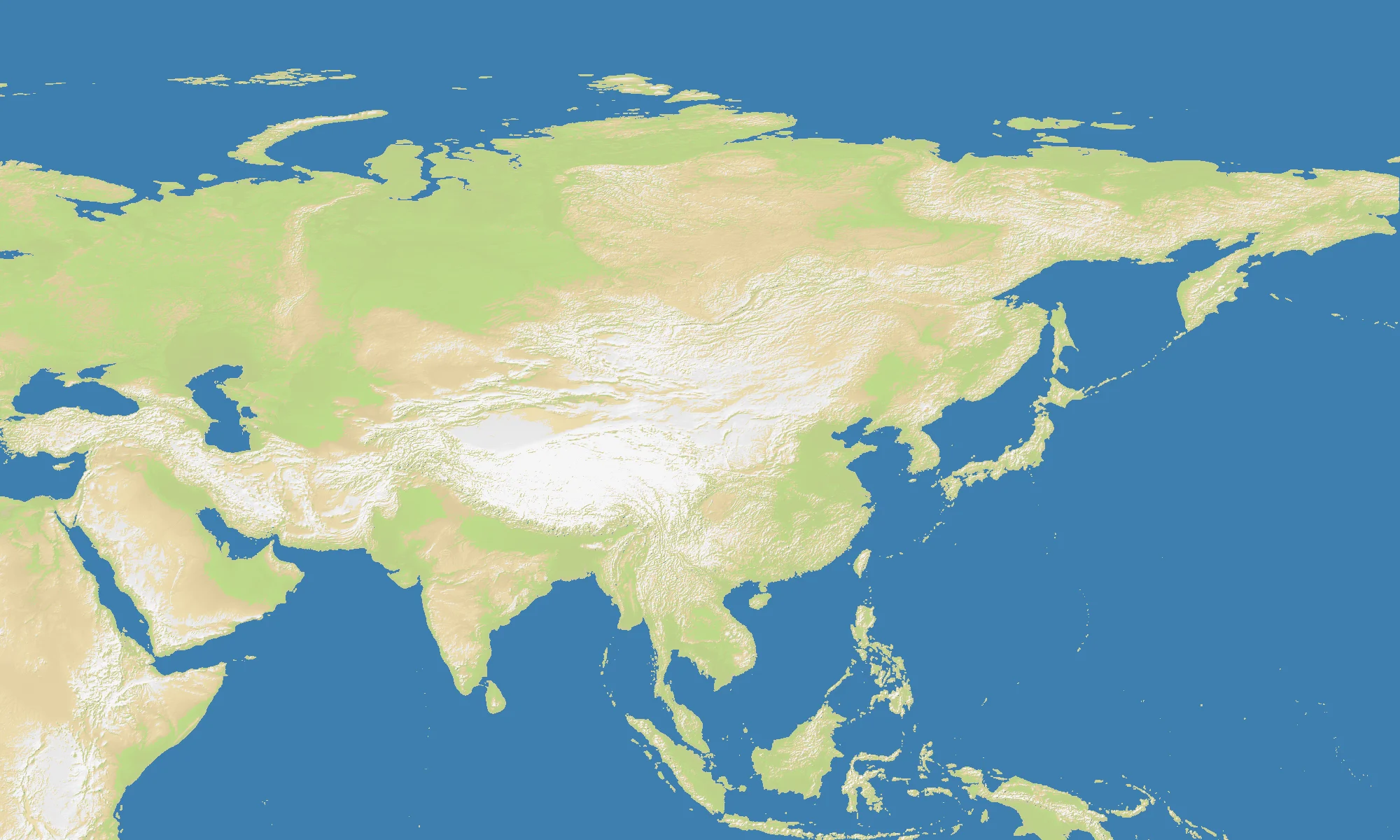
Asia is less a single landscape than a stack of worlds stitched together: Siberian taiga, Central Asian steppe, Himalayan wall, Indian subcontinent, Chinese river plains, Middle Eastern deserts, and the island fringes of Southeast Asia. The OpenFront Asia map captures that breadth in a wide 2000×1200 frame, appropriate for a continent that stretches from the Mediterranean-adjacent west to the Pacific-facing east far more than it stretches north to south.
At 45% land, the map leaves a slight majority to water, reflecting Asia’s long maritime rim along the Arctic, Pacific, and Indian Oceans. But the center of gravity is still inland. Mountain systems like the Himalayas, Hindu Kush, Tien Shan, and Tibetan Plateau break the continent into strategic compartments, while the Eurasian steppe and great river basins — the Yangtze, Yellow, Ganges, Indus, Mekong, and Ob-Yenisei-Lena systems further north — create very different modes of expansion.
With 25 nations, Asia feels spacious compared with Europe or Arctic. That lower density changes the tone: each starting position tends to have more room, more depth, and more time before full encirclement. The battles are less about surviving immediate crowding and more about choosing which sub-region will become your imperial base.
The History
130 BCE–1453 — The Silk Road Links Eurasia
The Silk Road was never one road but a web of caravan and maritime routes tying China, Central Asia, India, Persia, and the Mediterranean together. Geography made those exchanges possible: mountain passes, oasis corridors, and steppe highways turned Asia into the engine room of premodern global trade.
1206 — Genghis Khan Unifies the Mongols
The rise of the Mongol Empire transformed the Eurasian steppe into the center of world history. Within decades, Mongol armies had connected East Asia, Central Asia, the Middle East, and eastern Europe in the largest contiguous land empire ever assembled.
1757 — British India Begins at Plassey
The Battle of Plassey marked the beginning of British political dominance in India through the East India Company. It was a continental turning point: an offshore European power embedded itself in one of Asia’s richest regions and reshaped trade, warfare, and governance across South Asia.
1945–1979 — Cold War Asia Fractures into Proxy Fronts
From China and Korea to Vietnam, Afghanistan, and beyond, Asia became a central arena of Cold War conflict. Ideology mattered, but so did geography: peninsulas, mountain borders, jungle corridors, and maritime chokepoints all shaped how superpower rivalry played out.
The Battlefield
Terrain Overview
Asia is a scale map. Its most important feature is the coexistence of huge open zones and massive terrain barriers. The steppe favors sweeping expansion, India and eastern China reward consolidation in fertile cores, and the Himalayan-Tibetan complex acts as one of the strongest natural separators on any Earth map in OpenFront. Because there are only 25 nations across such a large theater, interior lines and long-term planning matter more than frantic early skirmishing.
Best Spawns
- North China Plain / eastern China — rich central position, multiple expansion vectors, and access to one of the continent’s classic historical cores
- Indian subcontinent — large semi-contained theatre with room to consolidate before pushing outward
- Central Asian steppe fringe — huge maneuver space and strong potential to pivot toward Russia, China, or the Middle East
Avoid
- Deep Siberian far north — enormous space but slow contact, slow growth, and difficult logistics across long distances
- Tight mountain corners near the Himalayas or Caucasus — defensible, but often too restrictive for a continental map this large
Strategic Insights
Asia rewards players who build an empire in layers. The smart move is usually to dominate one coherent sub-region first — China, India, the steppe, Southeast Asia, or the Middle East — and only then project outward. Because the map is wide and relatively short, east-west movement and positioning are usually more decisive than north-south pushes.
Fun Facts
- Asia has fewer nations than Europe in OpenFront, but each nation usually enjoys far more territorial depth because the continent itself is so large
- The 2000×1200 layout makes Asia feel horizontally expansive, which fits the real continent’s historic trade and invasion routes across Eurasia
- At 45% land, Asia sits between land-dominant maps like Black Sea and water-heavy ones like Aegean, making it a true mixed-theatre continental map