Arctic
Forty-four flags around a frozen ocean
Nations 44




The Geography
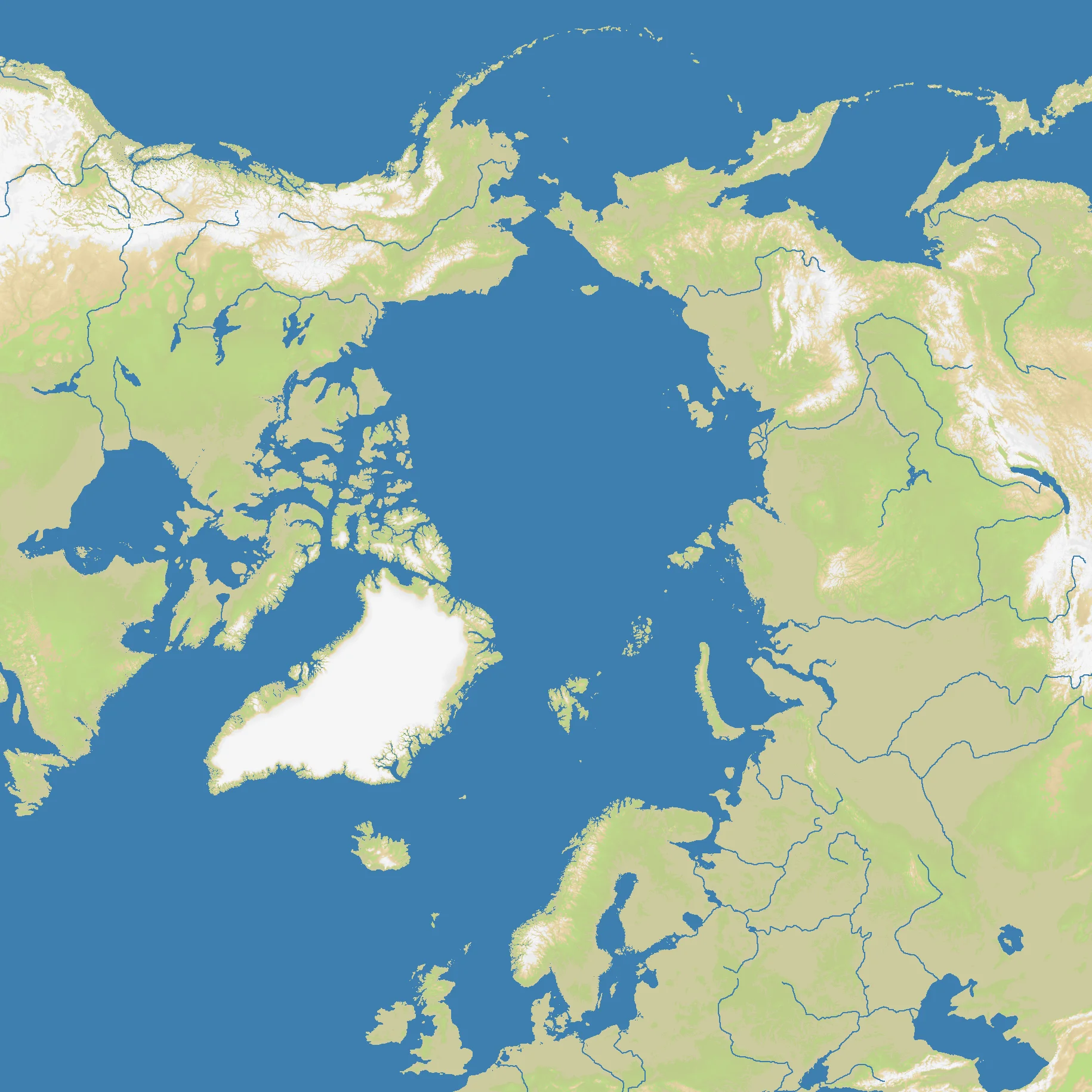
The Arctic is less a continent than a ring of continents around an ocean. North America, Greenland, Iceland’s northern approaches, Scandinavia, and Siberia all lean into the Arctic Ocean, while seas like the Barents, Kara, Laptev, Beaufort, and Chukchi carve the rim into separate theaters. The OpenFront Arctic map uses a near-square 1828×1828 frame that suits the polar perspective: the center is water and ice, while land arcs around it in a rough circle.
This map is exactly 50% land and 50% sea, and that perfect balance shapes every decision. No single power can ignore naval movement, but no one can live entirely off it either. Peninsulas, islands, and northern capes provide launch points into the ocean, while enormous landmasses in Siberia, Canada, and Greenland create long defensive lines that are hard to seal completely.
With 44 nations — the highest count of any regional map — Arctic is chaos by design. The early game is brutally crowded around the coasts, archipelagos, and straits. You are not fighting for one obvious historical heartland; you are fighting for breathing room on the edge of the world.
The History
1845 — Franklin and the Search for the Northwest Passage
Sir John Franklin’s doomed expedition became the most famous Arctic disaster of the nineteenth century. The search for his ships accelerated European mapping of the Canadian Arctic and fixed the Northwest Passage in the global imagination as both opportunity and trap.
1909 — Peary Claims the North Pole
Robert Peary’s claim to have reached the Pole remains controversial, but the symbolism mattered. By the early twentieth century, the Arctic had become a stage for national prestige, technological competition, and the idea that even the harshest spaces should be conquered.
1950s–1980s — The Cold War Turns North
The shortest missile and bomber routes between the United States and the Soviet Union ran over the Arctic. Radar chains, submarine patrols, and airbases turned the polar region from an explorer’s frontier into one of the most strategically sensitive military zones on Earth.
2007 — Russia Plants a Flag on the Seabed
A Russian expedition placed a titanium flag on the seabed beneath the North Pole, dramatizing modern competition over Arctic resources and maritime claims. Melting sea ice has only intensified arguments over shipping lanes, hydrocarbons, and sovereignty.
The Battlefield
Terrain Overview
Arctic rewards players who understand that the coastline is the real map. Landmasses are huge, but usable routes are concentrated around bays, island chains, and passages such as the Norwegian approaches, the Canadian archipelago, and the Bering gateway. Because the map is split 50-50 between land and sea, control of transition zones matters more than control of empty interior space.
Best Spawns
- Scandinavia / Barents approaches — dense contact, but excellent access to both European land routes and northern sea lanes
- Alaska / Bering side — strong edge positioning and control over one of the Arctic’s most important gateways
- Central Canadian Arctic islands — awkward at first, but defensible and rich in choke-based expansion options if managed well
Avoid
- Fully exposed Siberian north coast starts — vast frontage, too many adjacent rivals, difficult to secure early
- Tiny isolated islands near the center — strategically tempting but easy to surround before you can snowball
Strategic Insights
Arctic is not about clean fronts; it is about surviving the opening stampede. With 44 nations, diplomacy through positioning matters as much as raw strength: secure one flank, choose one corridor, and avoid becoming the obvious shared target. If you can stabilize through the early madness, the map opens into a fascinating midgame where naval mobility and continental depth are equally decisive.
Fun Facts
- Arctic has the highest nation count of any regional map in OpenFront: 44 separate starting powers circling one frozen ocean
- Its exact 50% land / 50% sea split makes it one of the most geometrically balanced maps in the game, even if the gameplay is anything but balanced at the start
- Unlike Amazon River’s corridor or Alps’ pure land grind, Arctic is a ring map — strategy wraps around the center instead of pushing across a single front